2026-04-27 成育医療研究センター
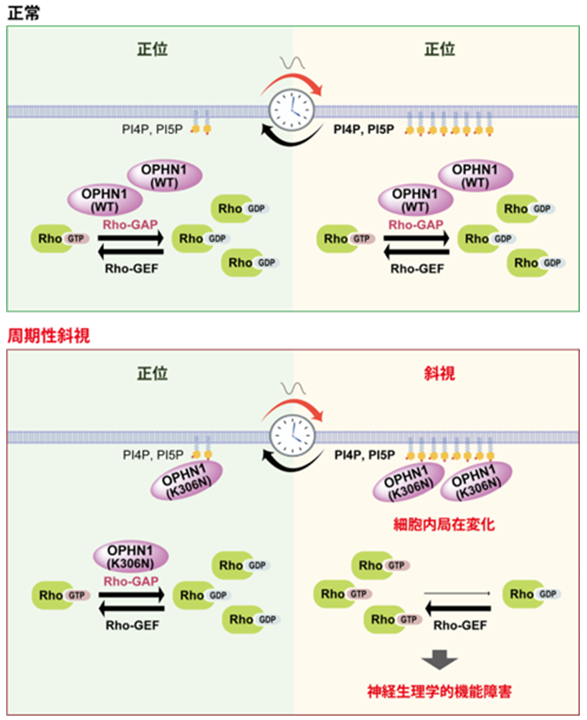
【図1:OPHN1バリアントによる周期性斜視発症モデル】
<関連情報>
周期性斜視に関連するがOPHN1症候群を伴わない新規OPHN1変異 A novel OPHN1 variant associated with cyclic strabismus but in the absence of OPHN1 syndrome
Sachiko Nishina,Satoshi Kofuji,Keiko Matsubara,Hazuki Anzai,Kyoko Hirakata,Yuya Hanazono,Yoshimi Okamoto-Uchida,Jun Hirayama,Nobutoshi Ito,Maki Fukami & Hiroshi Nishina
Scientific Reports Published:24 April 2026
DOI:https://doi.org/10.1038/s41598-026-48129-7
Abstract
Cyclic strabismus is a rare form of strabismus whereby individuals experience the disease in a pattern of alternating days with or without strabismus in a circadian rhythm-dependent manner. However, the molecular mechanism that underlies this rhythm is unknown. OPHN1 encodes a Rho GAP protein, and mutations specifically in the BAR or GAP domains of OPHN1 cause OPHN1 syndrome characterized by intellectual disability and often also strabismus. In this study, we identified a novel hemizygous variant of OPHN1 in a male patient with cyclic strabismus but without intellectual disability. This novel K306N variant affected the PH domain of OPHN1, and enhanced its ability to bind to the phosphatidylinositol phosphates (PIPs), PI4P and PI5P. We propose that this enhanced binding may affect the subcellular localization of the OPHN1 Rho GAP protein in a cyclic manner, leading to cyclic strabismus. Our work indicates that some cases of cyclic strabismus may be due to a gain-of-function variant of OPHN1.