2026-05-08 京都大学
作成:齊藤晋・牧野愛子
<関連情報>
- https://www.kyoto-u.ac.jp/ja/research-news/2026-05-08-0
- https://www.sciencedirect.com/science/article/pii/S2213597926000376
経時的な3次元光超音波イメージングはケロイド再発に関与する高酸素化微小血管を探知する Longitudinal three-dimensional photoacoustic imaging reveals hyperoxic perilesional microvasculature associated with keloid recurrence
Aiko Makino, Susumu Saito, Ayako Takaya, Tomoko Kosaka, Eiichi Sawaragi, Maria Chiara Munisso, Aya Yoshikawa, Yasufumi Asao, Hiroyuki Sekiguchi, Takayuki Yagi, Naoki Morimoto
Photoacoustics Available online: 23 April 2026
DOI:https://doi.org/10.1016/j.pacs.2026.100831
Abstract
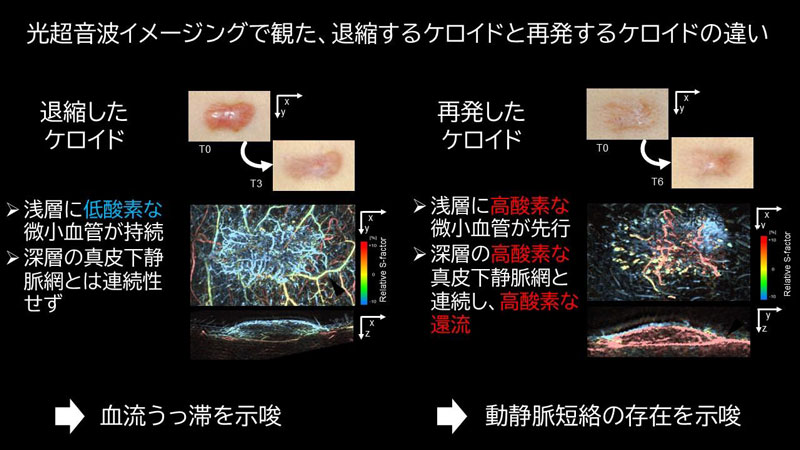
Keloids undergo repeated cycles of regression and recurrence; however, vascular dynamics associated with recurrence remain poorly understood. In this prospective time-series study, we investigated microvascular changes in keloids using longitudinal three-dimensional photoacoustic imaging combined with ultrasonography. Adult patients with trunk or extremity keloids receiving intralesional triamcinolone treatment underwent imaging at four time points over a 6-month period. Vascular morphology and oxygenation were evaluated in superficial and subdermal layers using dual-wavelength near-infrared illumination and relative S-factor values referenced to peri-keloid regions. Six keloids in five patients were analyzed. Regressive lesions demonstrated hypoxic superficial microvessels disconnected from hyperoxic subdermal vessels, whereas recurrent lesions showed emergence of hyperoxic superficial microvessels continuous with hyperoxic subdermal venous networks. Persistent subdermal venous hyperoxia was observed irrespective of clinical status. Combined three-dimensional and longitudinal photoacoustic imaging enabled spatiotemporal identification of activity-dependent microvascular alterations associated with keloid recurrence, supporting a potential arteriovenous shunting mechanism.