2026-05-12 埼玉大学
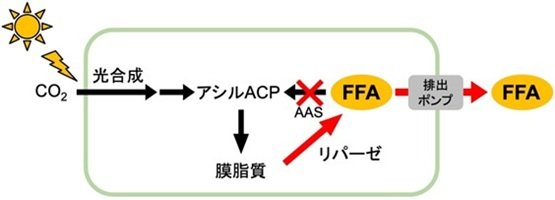
図2. FFAの細胞外生産のメカニズム
ラン藻Synechococcus elongatusをもとに、アシルACP合成を抑制し、排出ポンプとリパーゼの働きを強化しました。
<関連情報>
- https://www.saitama-u.ac.jp/topics_archives/202605121000.html
- https://link.springer.com/article/10.1186/s13068-026-02768-0
Synechococcus elongatus PCC 7942のガラクトリパーゼと排出トランスポーターの過剰発現による遊離脂肪酸の細胞外排出の促進 Overexpression of endogenous galactolipases and an efflux transporter enhances the secretion of extracellular free fatty acids by Synechococcus elongatus PCC 7942
Kotoha Nishimoto,Tsubasa Furushima,Taro Kadowaki,Haruhiko Jimbo,Norifumi Yamamoto,Kazutaka Ikeda,Nobuyuki Takatani,Makiko Aichi,Tatsuo Omata & Yoshitaka Nishiyama
Biotechnology for Biofuels and Bioproducts Published:30 April 2026
DOI:https://doi.org/10.1186/s13068-026-02768-0
Abstract
Background
Cyanobacterial mutants engineered for production of free fatty acids (FFAs) are potentially useful sources of biofuels, since the FFAs are secreted into the extracellular medium. The exploitation of such mutants circumvents intracellular storage limits and minimizes energy-intensive downstream extraction processes. However, in addition to the inactivation of the endogenous aas gene (encoding acyl-ACP synthetase) to prevent recycling of FFAs, construction of the FFA-producing mutants requires introduction of a transgene for a thioesterase that generates FFAs from acyl-ACP. For exploitation of such mutants for biofuel production at the industrial level, in particular in countries with strict rules about dissemination of genetically modified organisms, it is essential to avoid introduction of foreign transgenes.
Results
Using the markerless mutagenesis method, we replaced an internal 3.0-kb segment of the aas gene of Synechococcus elongatus PCC 7942 with a DNA fragment that included the ORFs of the endogenous genes for galactolipases (lipB and/or lipC) and the RND-type FFA efflux transporter (rndA1B1), which were fused, respectively, to the endogenous psbAII promoter. Under strong light (200 µmol photons·m-2·s-1), the resultant engineered strains overexpressed both the galactolipase(s) and the FFA efflux-transporter RND and secreted significantly greater quantities of FFAs into an overlaid layer of isopropyl myristate than the parental Δaas strain. Cultivation at a suboptimal temperature (25 °C, as compared to 32 °C) further enhanced the production of FFAs. The most abundant secreted fatty acid was palmitoleic acid (16:1), confirming that FFAs originated primarily from the deacylation of membrane lipids. The titer, production rate, and yield of FFAs in the best-performing transformant (Δaas::lipC-lipB-rndAB) were similar to those reported previously for other genetically modified cyanobacteria that produce extracellular FFAs.
Conclusions
Co-overexpression of endogenous galactolipases and the RND transporter resulted in efficient extracellular secretion of FFAs in engineered S. elongatus. Our approach should facilitate investigations directed toward industrial applications, particularly in countries with strict regulations related to the dissemination of genetically modified organisms, and it provides a promising platform for the sustainable production of biofuel precursors.