2026-05-19 神戸大学
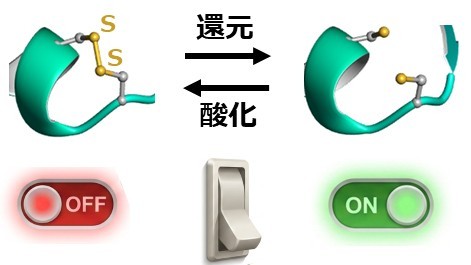
図1 光合成を操るジスルフィド結合(S-S結合)のタンパク質スイッチ ©田中謙也, CC BY
<関連情報>
- https://www.kobe-u.ac.jp/ja/news/article/20260519-67815/
- https://www.pnas.org/doi/10.1073/pnas.2600150123
ジスルフィド結合の還元電位の系統的な測定により、シアノバクテリアにおける非平衡酸化還元階層が明らかになった Systematic determination of disulfide bond reduction potentials reveals a nonequilibrium redox hierarchy in cyanobacteria
Kenya Tanaka, Akihiko Kondo, and Tomohisa Hasunuma
Proceedings of the National Academy of Sciences Published:May 19, 2026
DOI:https://doi.org/10.1073/pnas.2600150123
Significance
Disulfide bonds play diverse roles in proteins, ranging from structural stabilization to reversible regulation of enzyme activity, and they are central to controlling the CBB cycle in photosynthetic organisms. How easily each bond changes state is set by its reduction potential (Em), yet Em is known for only limited sites and usually measured in purified proteins removed from their natural partners. We developed a lysate-based redox proteomics method that determines hundreds of Em values across the cyanobacterial proteome in a native mixture of proteins. These data reveal a nonequilibrium hierarchy around thioredoxin: phosphoribulokinase operates near thioredoxin, whereas other CBB cycle enzymes are kept more oxidized. Our approach provides a broadly applicable strategy to quantify context-dependent Em that organize cellular metabolism.
Abstract
Disulfide bonds act as reversible switches that regulate cellular function in nearly all organisms. Their behavior is set by the midpoint potential (Em), yet Em is known for only a small number of sites, mostly in purified proteins studied away from their natural partners. We developed a mass-spectrometry workflow that measures Em directly from native cell lysates. By equilibrating proteins of the cyanobacterium Synechocystis sp. PCC 6803 in defined redox buffers and reading out the oxidation state of individual cysteines, we obtained 368 Em values across the proteome and validated them against purified proteins. A key example is the regulatory protein CP12: its Em in isolation differs strongly from the value measured in lysate and converges only when its physiological partner, thioredoxin, is included, showing that our approach captures the effective potentials that operate inside cells. Combining Em with absolute measurements of cysteine redox state in light and darkness, we mapped intracellular redox “operating points” for Calvin–Benson–Bassham (CBB) cycle enzymes. Phosphoribulokinase sits near thioredoxin, whereas fructose 1,6-bisphosphatase/sedoheptulose 1,7-bisphosphatase (F/SBPase) and CP12 are maintained at more oxidized, nonequilibrium states. These results reveal a hierarchical redox control network in photosynthetic metabolism and provide a general strategy for measuring context-dependent redox switches in living systems.