2026-05-22 国立がん研究センター
<関連情報>
- https://www.ncc.go.jp/jp/information/researchtopics/2026/0522/index.html
- https://aacrjournals.org/clincancerres/article/doi/10.1158/1078-0432.CCR-25-4936/785235/Comprehensive-Genomic-and-Transcriptomic
進行性固形腫瘍におけるMTAP欠損の包括的なゲノムおよびトランスクリプトーム解析 Comprehensive Genomic and Transcriptomic Characterization of MTAP Loss Across Advanced Solid Tumors
Kyosuke Seguchi;Takao Fujisawa;Sadakatsu Ikeda;Yu Oyama;Norio Nonomura;Chigusa Morizane;Hiroji Iwata;Susumu Okano;Hidemichi Watari;Kenjiro Namikawa;Shigenori Kadowaki;Makoto Ueno;Eiji Oki;Shogen Boku;Satoshi Yuki;Wataru Yamagami;Tomohiro Nishina;Toshihiro Kudo;Naoki Takahashi;Hideaki Bando;Takayuki Yoshino;Yoshiaki Nakamura
Clinical Cancer Research Published:May 18 2026
DOI:https://doi.org/10.1158/1078-0432.CCR-25-4936
Abstract
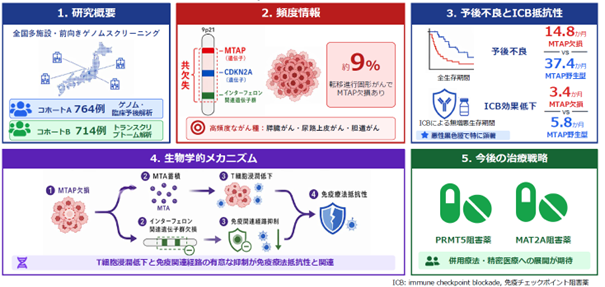
Purpose: Methylthioadenosine phosphorylase (MTAP) is a tumor suppressor gene, with loss of MTAP occurring in approximately 15% of solid tumors; however, its molecular and clinicopathological significance remains incompletely defined.
Experimental Design: We conducted a multicenter observational study using two nationwide Japanese genomic screening programs, defining MTAP loss as homozygous deletion. In the MONSTAR-SCREEN-1 study (cohort A; n = 773), patients underwent tissue-based next-generation sequencing to evaluate MTAP status, co-alterations, clinical outcomes, and therapeutic efficacy. In MONSTAR-SCREEN-2 (cohort B; n = 714), multiomic analyses were conducted using whole exome and whole transcriptome sequencing, including xCell immune deconvolution and gene set enrichment analysis (GSEA), to characterize the tumor immune microenvironment and signaling pathways associated with MTAP loss.
Results: Among 764 patients in cohort A, MTAP loss was identified in 71 cases. MTAP loss strongly co-occurred with CDKN2A/B deletions and was associated with lower tumor mutational burden and microsatellite stable status. Patients with MTAP loss had significantly shorter overall and progression-free survival under immune checkpoint blockers (ICB) treatment. In MTAP loss tumors, transcriptomic analyses of cohort B revealed reduced infiltration of T cells, while GSEA showed enrichment of cell-cycle, RNA-processing, and DNA repair pathways, and depletion of immune-related and metabolic pathways.
Conclusions: MTAP loss defines a clinically adverse subset across advanced solid tumors, characterized by co-deletion of CDKN2A/B and type I interferon cluster genes, reduced T-cell infiltration, and resistance to ICB. These findings provide a mechanistic context for ICB resistance.