2026-05-29 国立循環器病研究センター
<関連情報>
- https://www.ncvc.go.jp/pr/release/pr_52629/
- https://j-stroke.org/journal/view.php?doi=10.5853/jos.2025.05848
アジア人における心房細動関連脳卒中に対する早期抗凝固療法と後期抗凝固療法の転帰:ELANサブグループ解析 Outcomes of Early Versus Later Anticoagulation in Asian Atrial Fibrillation–Related Stroke: ELAN Subgroup Analysis
Takeshi Yoshimoto, Masafumi Ihara, P N Sylaja, Jean-Benoît Rossel, Shigeru Fujimoto, Yasuyuki Iguchi, Rajsrinivas Parthasarthy, Vijaya Pamidimukkala, Yusuke Yakushiji, Thomas Iype, Makoto Nakajima, Dheeraj Khurana, Vivek Nambiar, Hisanao Akiyama, Kazunori Toyoda, Angelika Alonso, Sven Poli, Caterina Kulyk, Nicoletta G. Caracciolo, Dimitri Hemelsoet, Ana Paiva Nunes, Jeyaraj Durai Pandian, Jesse Dawson, Urs Fischer,Masatoshi akoga
Journal of Stroke Published:May 28, 2026
DOI:https://doi.org/10.5853/jos.2025.05848
Abstract
Background and Purpose
We aimed to evaluate whether early versus late initiation of direct oral anticoagulant (DOAC) after acute ischemic stroke (AIS) yields different safety and efficacy outcomes in Asian versus non-Asian patients.
Methods
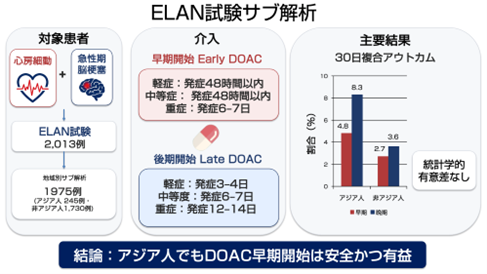
We analyzed Early versus Late initiation of direct oral Anticoagulants in post-ischaemic stroke patients with atrial fibrillatioN (ELAN) trial data from 2,013 AIS patients with atrial fibrillation (AF) randomized to early (≤48 hours for minor/moderate stroke, 6–7 days for major stroke) or late DOAC initiation (3–4 days for minor ischemic stroke, 6–7 days for moderate ischemic stroke, 12–14 days for major ischemic stroke). Patients were categorized by region as Asian (Japan and India) or non-Asian. The primary outcome was a composite of major extracranial bleeding, symptomatic uncerintracranial hemorrhage (SICH), recurrent ischemic stroke, systemic embolism (SE), or vascular death at 30 days (trial registration: ClinicalTrials.gov number, NCT03148457).
Results
Among 1,975 patients, 245 were Asian (192 from Japan and 53 from India) and 1,730 were non-Asian. The primary outcome occurred in 6.5% of Asian patients (4.8% early vs. 8.3% late) and 3.1% of non-Asian patients (2.7% vs. 3.6%) (p<0.01). Higher rates of recurrent ischemic stroke (4.1% [2.4% vs. 5.8%] vs. 1.7% [1.3% vs. 2.1%], p=0.02) and SE (2.0% [0.8% vs. 3.3%] vs. 0.5% [0.4% vs. 0.6%], p=0.02) accounted for this difference. No significant differences were observed in major extracranial bleeding, SICH, recurrent ischemic stroke, SE, or vascular death. No significant interaction was observed between region and treatment allocation.
Conclusions
Although Asian patients had worse baseline profiles and outcomes, treatment effects did not differ by region, supporting the generalizability of early DOAC initiation in Asian AIS patients without region-specific timing modifications.