2026-06-03 カリフォルニア大学サンディエゴ校(UCSD)
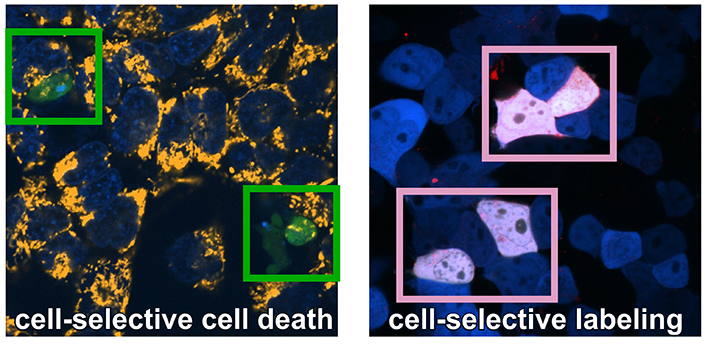
TRACE allows chemistry to occur only in selected cells. Enzyme-activated tetrazine cages enable targeted cell death (left) and targeted fluorescent labeling (right). (cr: Devaraj lab / UC San Diego)
<関連情報>
- https://today.ucsd.edu/story/new-step-toward-programmable-chemistry
- https://www.nature.com/articles/s41589-026-02240-y
酵素活性化ケージドテトラジンを用いた細胞型特異的な生体直交化学の実現 Achieving cell-type-specific bioorthogonal chemistry using enzyme-activated caged tetrazines
Caroline H. Knittel,Stormi R. Chadwick,Jacob A. Vance,Cedrik Kuehling & Neal K. Devaraj
Nature Chemical biology Published:03 June 2026
DOI:https://doi.org/10.1038/s41589-026-02240-y
Abstract
Bioorthogonal reactions have revolutionized molecular biology through the conjugation of molecules within cellular environments. However, classical bioorthogonal reagents often suffer from nonspecific reactivity across diverse physiological contexts, diminishing their precision. This limitation presents considerable challenges in complex biological systems where multiple cell types coexist. Here we demonstrate tetrazine release and activation by cellular enzymes (TRACE), a method enabling cell-type-specific bioorthogonal chemistry. TRACE uses caged dihydrotetrazine derivatives, which remain inert until activated by specific cellular enzymes. Optimizing the electronic properties of the dihydrotetrazine scaffold enables rapid uncaging and activation of tetrazines within minutes. We demonstrate the utility of TRACE for the targeted release of cytotoxic drugs, selectively impacting the viability of enzyme-expressing cells in cocultures. Additionally, our method facilitates the delivery of imaging agents to subcellular structures in an enzyme-activity-dependent manner. TRACE represents a promising approach for programmable bioorthogonal chemistry in therapeutic and imaging applications.