2026-06-08 中国科学院(CAS)
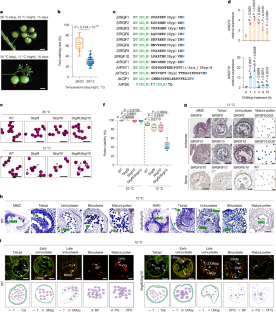
◆RGFは通常温度ではほとんど発現せず、低温ストレスを受けた際にのみ花粉発達中の葯タペート細胞で活性化される。このペプチドは受容体SlRGFR6および共受容体SlSERKに認識され、イオンチャネルSlCNGC16/18を活性化してカルシウム流入を誘導する。その結果、タペート細胞の適切なプログラム細胞死が促進され、花粉への栄養供給が維持されることで低温による花粉退化を防ぐ。圃場試験では、このシグナル経路の適度な活性化によりトマトの低温被害による収量減少を33.9~52.2%回復させ、水稲でも約18%の収量損失を軽減した。この仕組みは双子葉植物・単子葉植物に広く保存されており、ダイズやトウモロコシへの応用も進められている。平常時の生育を損なわず、必要時のみ耐寒性を発揮する「オンデマンド型」耐寒育種の実現につながる成果である。
<関連情報>
- https://english.cas.cn/newsroom/research-news/202606/t20260604_1161083.shtml
- https://www.nature.com/articles/s41586-026-10603-7
低温誘導ペプチドシグナル伝達が花粉の耐性と作物収量を確保する Cold-induced peptide signalling secures pollen resilience and crop yield
Shudong Chen,Yupan Zou,Huanshuo Cui,Qingfeng Dong,Dandan Yang,Xiaozhen Huang,Shujing Cheng,Peiyong Xin,Jinfang Chu,Wen Song & Cao Xu
Nature Published:03 June 2026
DOI:https://doi.org/10.1038/s41586-026-10603-7
Abstract
Cold weather cause severe crop losses. Climate change exacerbates the unpredictability and frequency of such weather events, highlighting the need for cold-resilient crops1. Cold-induced pollen abortion and reproductive failure during flowering are major causes of yield losses2,3, yet the molecular mechanisms and signalling pathways that underlie cold resilience in pollen development remain unknown. Here we identify a subset of cold-responsive small signalling peptides in the RGF–GLV–CLEL family, SlRGF9 and SlRGF10, that control cold resilience in tomato pollen. After loss of function of SlRGF9 and SlRGF10, tomato plants (Solanum lycopersicum) showed no defects under normal conditions, but pollen abortion was observed after cold stress. The leucine-rich repeat receptor-like kinases, SlRGFR6 and SlSERK proteins, form cell-surface receptor complexes that bind to these cold-induced SlRGFs. Furthermore, SlRGF–SlRGFR6 signalling activates calcium influx through cyclic-nucleotide-gated channels, counteracting cold-delayed programmed cell death and ensuring tapetum degradation to support microspore development. Upregulating SlRGF9 and SlRGF10 in tomato plants prevents cold-induced yield losses by up to 52%. This cold-responsive peptide signalling pathway is conserved across dicots and monocots. For example, upregulation of RGF homologues in rice (Oryza sativa) boosts cold resilience in pollen and recovers 18.3% of grain yield loss. Our findings uncover a core peptide signalling axis that governs cold resilience in pollen and has broad potential for safeguarding crop productivity against cold stress.