2026-06-22 エディンバラ大学
<関連情報>
- https://www.ed.ac.uk/news/algae-microbots-take-aim-at-bladder-cancer
- https://www.nature.com/articles/s41565-026-02195-0
腔内化学療法のための機械知能型マルチモーダルアルゴリズム Machine-intelligent multimodal algebot for intracavitary chemotherapy
Lin Lin,Haohui Li,Qi Zhou,Qi Ding,Xiang Sun,Jing Hu,Zhangli Zhao,Yaning Qin,Tiancheng Jiang,Honghao Ye,Xiaozhen Wu,Honghan Liu,Lu Huang,Chenghao Huang,Yahui Gao,Jinyao Tang,Xing Ma & Xiaohui Yan
Nature Nanotechnology Published:22 June 2026
DOI:https://doi.org/10.1038/s41565-026-02195-0
Abstract
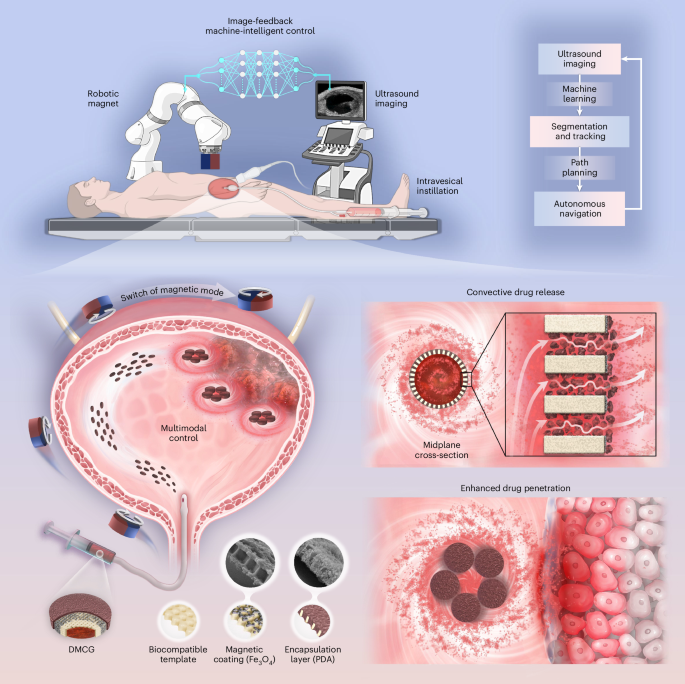
Intracavitary drug instillation is a crucial therapeutic strategy for treating bladder cancer. However, current methods are limited in efficacy due to insufficient tumour targeting and drug penetration across tissue barriers in pathophysiological conditions. Here we devise biohybrid magnetic algae microrobots with hierarchical nanoporous structure and develop an ‘algebot’-mediated, non-contact convective transport strategy to synergistically integrate targeted carrier transport, selective drug release and ultrafast tissue penetration. Our approach leverages machine-intelligent image feedback for autonomous navigation, magnetite-endowed multimodal control for reconfigurable swarming and flow-tuned convective diffusion for on-demand therapeutic delivery. We exemplify this approach with doxorubicin-loaded magnetic Coscinodiscus granii evaluated in a murine model of bladder tumour, demonstrating an over tenfold increase in drug permeation and substantially reduced tumour burden to less than 3% compared with conventional intravesical instillation in a preclinical trial of 1-week therapy without inducing systemic toxicity. Our drug delivery system offers a non-invasive solution to overcome complex biological barriers, advancing the efficacy and safety of intracavitary chemotherapy.