2026-06-26 東京科学大学
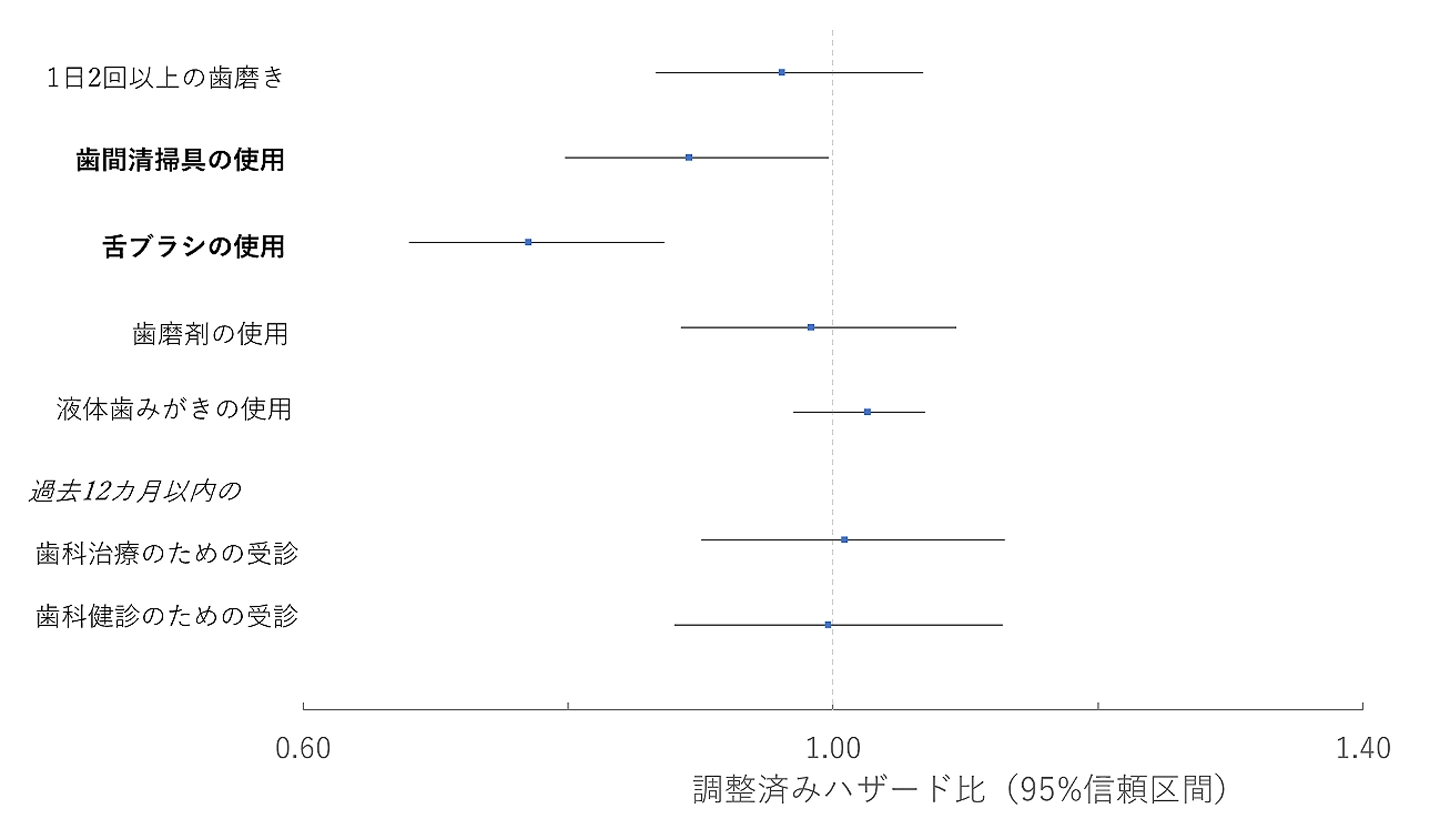
図1. 日常的な口腔保健行動と高齢者の全死因死亡リスクとの関連(n=9,676、6年の追跡)
<関連情報>
- https://www.isct.ac.jp/ja/news/1bz0ie035mmy#top
- https://www.sciencedirect.com/science/article/pii/S0300571226004598
高齢日本人における日常的な口腔衛生習慣と全死因死亡率:6年間のコホート研究 Routine oral health practices and all-cause mortality among older Japanese adults: A 6-year cohort study
Kewei Wang, Yusuke Matsuyama, Sakura Kiuchi, Taro Kusama, Duc Sy Minh Ho, Jun Aida
Journal of Dentistry Available online 23 May 2026
DOI:https://doi.org/10.1016/j.jdent.2026.106789
Abstract
Objectives
To examine whether multiple routine oral health practices reduce all-cause mortality, and how these associations are modified by sociodemographic, behavioral, and health related factors.
Methods
Data were derived from the Japan Gerontological Evaluation Study (JAGES), with participants enrolled between 3 October and 14 November 2016. Participants who were not certified for long-term care insurance and completed the questionnaire version including oral health practice items were eligible; edentulous or not functionally independent individuals were excluded. Participants were categorized according to engagement in seven routine practices: toothbrushing ≥twice/day, use of interdental cleaner, tongue cleaner, toothpaste, mouthwash, and dental visits for treatment or checkups in the past 12 months. The outcome was all-cause mortality through 20 June 2023. Hazard ratios (HRs) and 95% confidence intervals (CIs) were estimated using inverse probability weighted Cox proportional hazard models, adjusting for confounding. For oral health practices exhibiting significant association, moderator wide analyses were conducted to explore potential effect modification by age, sex, education, income, smoking, alcohol consumption, body mass index, walking time, living status, self-rated health, number of teeth, and depression.
Results
During the 6-year follow-up, the mortality incidence rate was 17.3/1000 person-year among 9676 participants (46.5% male; mean age=73.7 ± 5.9 years). Significant risk reductions in all-cause mortality were observed for interdental cleaner use (HR=0.89; 95% CI=0.80–0.99) and tongue cleaner use (HR=0.77; 95%CI=0.68–0.87). No significant effect modification was detected.
Conclusions
In this nationwide cohort study, the use of interdental and tongue cleaners was associated with lower all-cause mortality among community-dwelling Japanese older adults during 6 years of follow-up.
Clinical significance
The results suggest that simple and low-cost practices may contribute to healthy longevity in ageing societies, and support further investigation into potential mechanisms, including pathways related to aspiration and respiratory infections.