2026-06-26 ジョージア工科大学
<関連情報>
- https://research.gatech.edu/bacteria-can-learn-and-form-memories-without-brain
- https://journals.aps.org/prxlife/abstract/10.1103/5zbg-8vll
単一細菌細胞におけるマルチタイムスケール適応と創発的学習 Multi-Timescale Adaptation and Emergent Learning in Single Bacterial Cells
Josiah C. Kratz, Huijing Wang, Fangwei Si, and Shiladitya Banerjee
PRX Life Published :15 May, 2026
DOI: https://doi.org/10.1103/5zbg-8vll
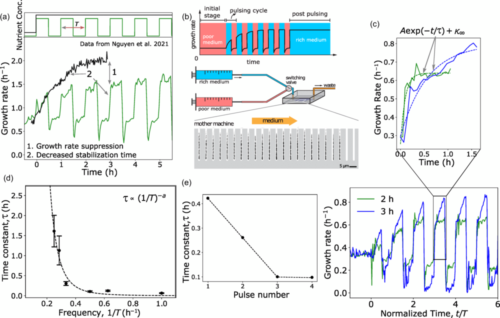
Abstract
How do single-celled organisms adapt and learn to survive in unpredictable environments without the benefit of a nervous system? In this study, we provide experimental and theoretical evidence that single bacterial cells exhibit sophisticated learninglike behavior in changing environments. Using a custom microfluidic platform, we tracked individual E. coli cells in fluctuating nutrient conditions and found that bacteria do not merely react to the present; they integrate their environmental history to tune their future growth. We show that this adaptation process is scale-free, meaning cells possess a memory that stretches across multiple timescales, from minutes to hours. To explain this, we developed a mathematical framework based on fractional-order dynamics, demonstrating that a dynamic, power-law memory governs how cells integrate environmental history, which we validate with additional nutrient perturbation experiments. We demonstrate that this memory emerges naturally from the cell’s internal machinery, specifically a heterogeneous population of ribosomes that react at different speeds. This mechanism reveals a strategic tradeoff between cellular adaptation speed and growth rate, which we confirm experimentally in pulsatile nutrient environments. By mapping the reaction-network architecture underlying bacterial physiology onto the logic of artificial recurrent neural networks, we show that even the simplest unicellular organisms implement complex computational strategies. Our findings establish a new foundation for understanding learning in non-neuronal systems, revealing how single cells use their history to navigate a changing environment.