2026-06-29 愛媛大学
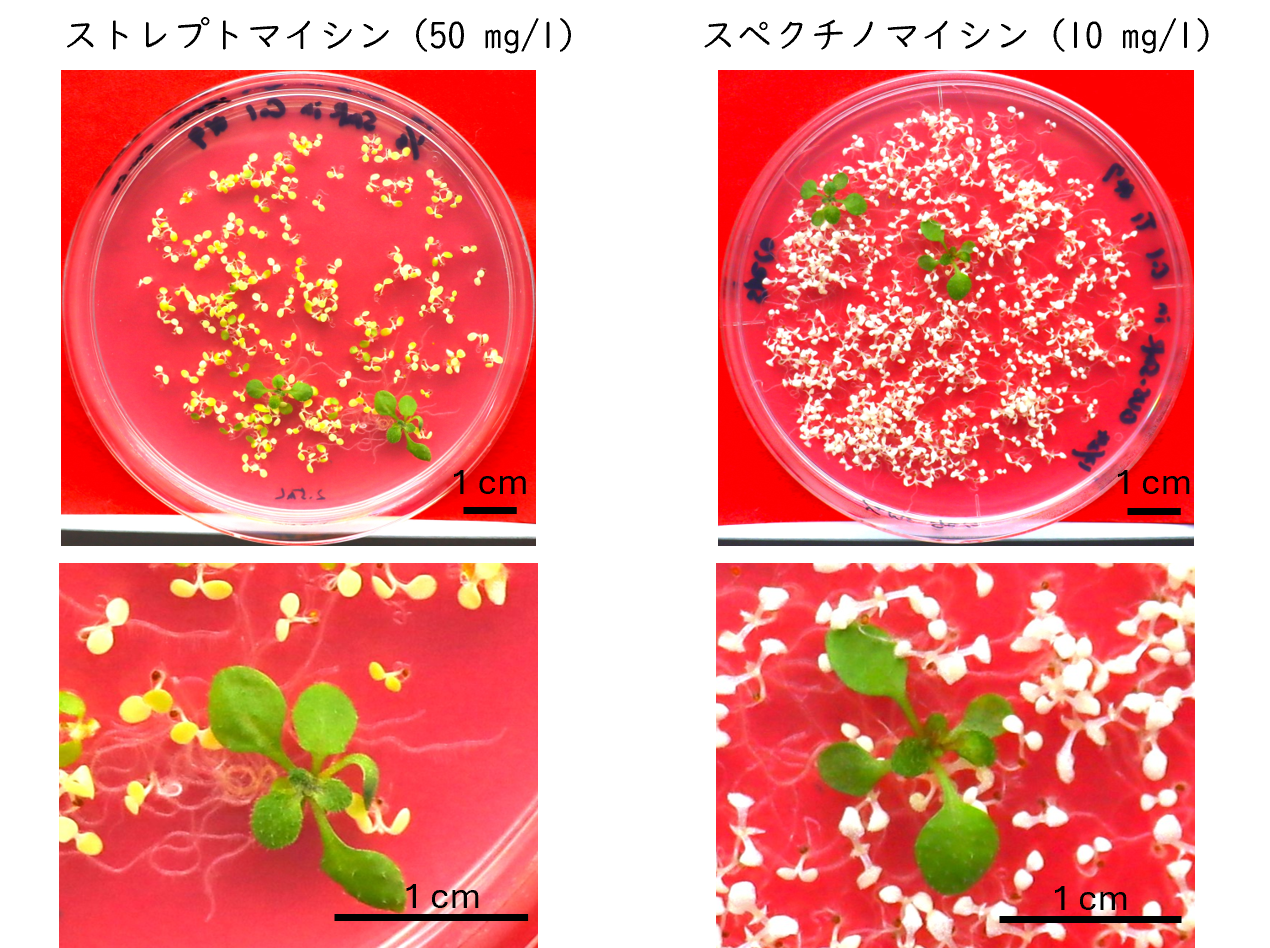
ストレプトマイシン、スペクチノマイシンによる形質転換シロイヌナズナT1世代の選抜上段:選抜培地の全体図、下段:形質転換体候補個体の拡大図
<関連情報>
- https://www.ehime-u.ac.jp/data_relese/pr_20260629_agr/
- https://www.ehime-u.ac.jp/wp-content/uploads/2026/06/pr_20260629_agr.pdf
- https://www.jstage.jst.go.jp/article/plantbiotechnology/43/2/43_26.0420b/_article
シロイヌナズナの核形質転換におけるストレプトマイシン/スペクチノマイシン選択のためのシンプルなSmR選択マーカー遺伝子 A simple SmR selectable marker gene for Streptomycin/Spectinomycin selection in Arabidopsis nuclear transformation
Aoha Miki, Shunya Hirata, Juna Akiyama, Mana Shimatani, Kappei Kobayashi, Hidetaka Kaya
Plant Biotechnology Published:June 20, 2026
DOI:https://doi.org/10.5511/plantbiotechnology.26.0420b
Abstract
Selectable marker genes are essential for recovering rare transformants during plant genetic transformations. However, only a limited number of markers are routinely used in Arabidopsis thaliana, particularly for nuclear transformation by the floral dip method. Aminoglycoside-3″-adenylyltransferase (AadA) has been widely used in plastid transformation to confer resistance to Streptomycin and Spectinomycin; however, its applicability to nuclear transformation in Arabidopsis has not been systematically examined. Here, we evaluated an Arabidopsis-codon-optimized AadA1 (Streptomycin/Spectinomycin Resistance: SmR) gene derived from Escherichia coli and lacking any plastid-targeting sequence, as a selectable marker for Arabidopsis nuclear transformation. Dose–response analyses revealed consistent Streptomycin and Spectinomycin sensitivity profiles across the four accessions (Col, L. er, Ws, and C24). When introduced via Agrobacterium-mediated floral dip, SmR conferred robust resistance to 50 mg l−1 Streptomycin or 10 mg l−1 Spectinomycin, enabling clear visual discrimination between resistant transformants and bleached non-transformants. Segregation analyses of T2 progeny revealed Mendelian 3 : 1 ratios, indicating successful transformation of the nuclear genome. Importantly, SmR transformants remained fully sensitive to Kanamycin and Hygromycin, demonstrating that SmR does not confer cross-resistance to these commonly used antibiotics. This compatibility enables the simultaneous use of Spectinomycin, Kanamycin, and Hygromycin for triple selection, allowing efficient isolation of triple transgenic plants. These results establish the non-targeted SmR as an efficient and cost-effective selectable marker for Arabidopsis nuclear transformation and expand the practical repertoire of plant selectable marker systems.