
2026-06-30 京都工芸繊維大学
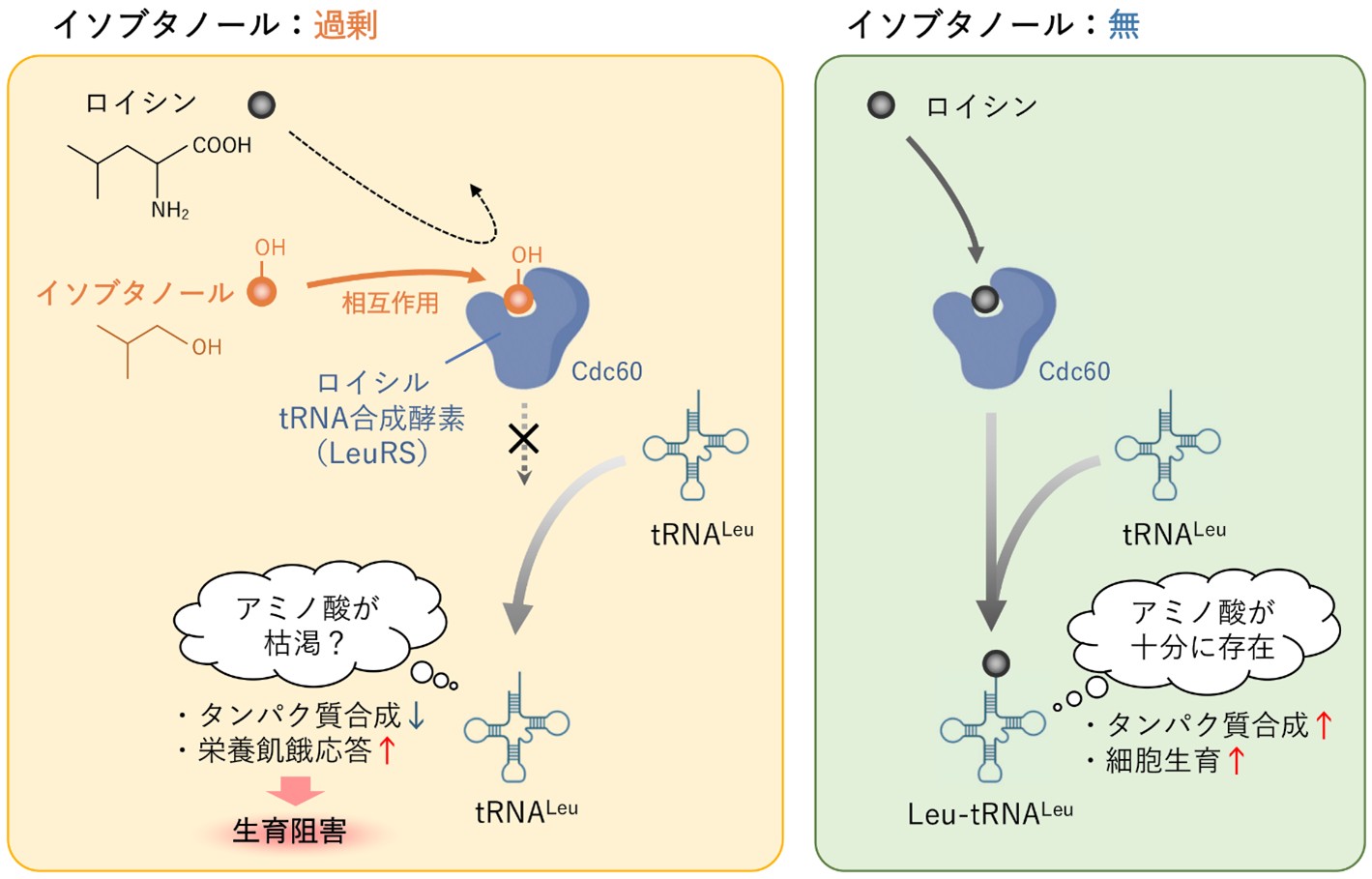
本研究成果の概要
<関連情報>
- https://www.kit.ac.jp/2026/06/news260630/
- https://www.kit.ac.jp/wp/wp-content/uploads/2026/06/news260630.pdf
- https://www.jbc.org/article/S0021-9258(26)02100-9/fulltext
サッカロミセス・セレビシエにおけるイソブタノールによる増殖阻害の分子標的としてのロイシルtRNA合成酵素 Leucyl-tRNA Synthetase as a Molecular Target of Isobutanol-Mediated Growth Inhibition in Saccharomyces cerevisiae
Mano Hasegawa ∙ Nodoka Oshimura ∙ Kaho Hitomi ∙ Ayako Furukawa ∙ Kenji Sugase ∙ Kouichi Kuroda
Journal of Biological Chemistry Published:June 4, 2026
DOI:https://doi.org/10.1016/j.jbc.2026.113228
Abstract
Our dependence on fossil fuels and ongoing environmental degradation urgently require sustainable energy solutions. Biofuels that do not rely on fossil resources have attracted significant scientific interest. Among these, isobutanol produced by yeast is a promising next-generation biofuel owing to its high energy density and compatibility with existing fuel infrastructure. However, the inherent intolerance of yeast to isobutanol constrains its production, posing a major barrier to the large-scale implementation of bio-based isobutanol. Here, we provide compelling evidence that supplementation with excess branched-chain amino acids (BCAAs), particularly leucine, alleviates isobutanol-induced growth inhibition in yeast. Using saturation transfer difference nuclear magnetic resonance (STD-NMR) spectroscopy and structural modeling, we showed that isobutanol directly interacts with cytoplasmic leucyl-tRNA synthetase (LeuRS), acting as a competitive inhibitor of leucine binding. Collectively, these findings reveal the mechanistic basis by which isobutanol inhibits yeast growth, offering new insights into enhancing isobutanol tolerance and increasing isobutanol biosynthesis in yeast.
.jpg "小脳アストロサイト多様性の起源を解明 ― 世界最先端Xenium解析で前駆細胞の時間制御分子機構を明らかに ―")