2026-06-01 東北大学
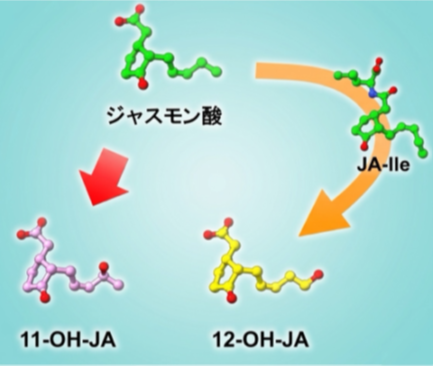
図1. 本研究の概略図
<関連情報>
- https://www.tohoku.ac.jp/japanese/2026/06/press20260601-05-jasmonic.html
- https://www.nature.com/articles/s41467-026-73528-9
(3R ,7S ) -11-ヒドロキシジャスモン酸は、シロイヌナズナにおけるジャスモン酸異化の主要な酸化副産物である (3R, 7S)-11-hydroxy-jasmonic acid is a major oxidative shunt product of jasmonic acid catabolism in Arabidopsis thaliana
Kotaro Matsumoto,Maria Mitsui,Takuya Kaji,Naoki Kitaoka,Ruiqi Gao,Taketomo Otaki,Yuho Nishizato,Hideyuki Matsuura & Minoru Ueda
Nature Communications Published:21 May 2026
DOI:https://doi.org/10.1038/s41467-026-73528-9 Unedited version
Abstract
Jasmonoyl-L-isoleucine (JA-Ile) is a pivotal oxylipin hormone that coordinates growth-defense trade-offs, and its precursor jasmonic acid (JA) is therefore subject to tight metabolic control. For more than a decade, the prevailing dogma has held that jasmonate turnover is dominated by C12-hydroxylation, with JOX dioxygenases acting on JA and CYP94 monooxygenases acting on JA-Ile. Here we revise this dogma by showing that hydroxylation at the C11 position constitutes a major deactivation shunt of JA turnover. Using chemically synthesized (3 R,7S)−11-hydroxy-JA (11-OH-JA) of naturally occurring stereochemistry as a standard, we unambiguously identify 11-OH-JA as the principal shunt product that accumulates in wounded Arabidopsis thaliana. In vitro enzymatic assays, in silico docking, and metabolite analyses in the jox quadruple mutant (joxQ) reveals that JOX1/2/3/4 exclusively converted JA to 11-OH-JA, whereas 12-OH-JA arose from distinct pathway. Moreover, 11-OH-JA failed to bind the COI1–JAZ co-receptor, establishing it as a biologically inactive endpoint of JA catabolism. These findings correct a long-standing misattribution of the JOX product to 12-OH-JA and redefine the metabolic framework of jasmonate. This study provides insights into JA catabolism, highlighting 11-OH-JA as a crucial factor in the attenuation of jasmonate signaling, and thereby redefining the framework of JA turnover in A. thaliana.