2026-07-01 コペンハーゲン大学(UCPH)
<関連情報>
- https://news.ku.dk/all_news/2026/06/researchers-to-teens-get-to-bed–its-good-for-your-blood-sugar/
- https://academic.oup.com/sleep/advance-article/doi/10.1093/sleep/zsag158/8711253
夜間の睡眠時間と覚醒時血糖値:自由生活を送る青年における持続血糖モニタリングとの関連性 Night-to-Night Sleep Duration and Wake-Anchored Glycaemia: Associations with Continuous Glucose Monitoring in Free-Living Adolescents
David Horner,Kristen Evensen,Zhi Ye,Marie Jahn,Kaare Tranæs,Jonathan Thorsen,Thomas Ragnar Wood,Kristi Storoschuk,Nanette Mol Debes,Jannet Svensson,…
Sleep Published:18 June 2026
DOI:https://doi.org/10.1093/sleep/zsag158
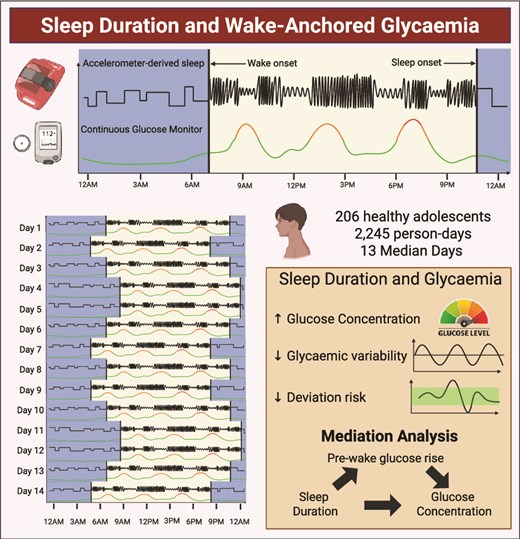
Graphical Abstract
Abstract
Study Objectives
Sleep duration influences metabolic health, but the impact of daily sleep variation on next-day glycaemia in healthy individuals under real-world conditions is poorly understood.
Materials and methods
We studied 206 adolescents (18 years) from the Copenhagen Prospective Studies on Asthma in Childhood 2000 (COPSAC2000) cohort with 2245 person-days of overlapping accelerometer-derived sleep and continuous glucose monitoring (CGM) recordings (median 13 days, IQR 9-13). Sleep duration was assessed using wrist-worn accelerometry, and glycaemic concentration, variability, and risk indices were derived from CGM during the accelerometer-defined waking period. Associations were examined using linear mixed-effects models adjusted for sociodemographic, behavioural, circadian, and cardiometabolic factors, with random effects of individuals across repeated days.
Results
Each additional hour of sleep was associated with higher next-day glycaemic concentration (median β 0.39 mg/dL [0.15, 0.63], p = .002), lower variability (standard deviation (SD) mg/dL β -0.12 [-0.23, -0.01], p = .036), and reduced deviation risk (Average Daily Risk Range (ADRR), indicating lower risk of extreme glucose excursions; β -0.27 [-0.43, -0.10], p = .002). Within-person deviations in sleep predicted next-day glycaemic concentration and deviation risk, whereas habitual between-person differences were more strongly associated with variability. Higher daytime glycaemic variability predicted shorter subsequent sleep (β -0.11 h [-0.18, -0.05], p < 0.001). The early-morning pre-wake glucose rise partly mediated the link between longer sleep and higher next-day median glucose (indirect effect 5.0%, p = 0.036).
Conclusions
These findings indicate dynamic, bidirectional coupling between sleep and glucose regulation in free-living adolescents, with longer sleep associated with lower next-day glycaemic variability and reduced risk of extreme glucose excursions.