2026-07-08 大阪公立大学
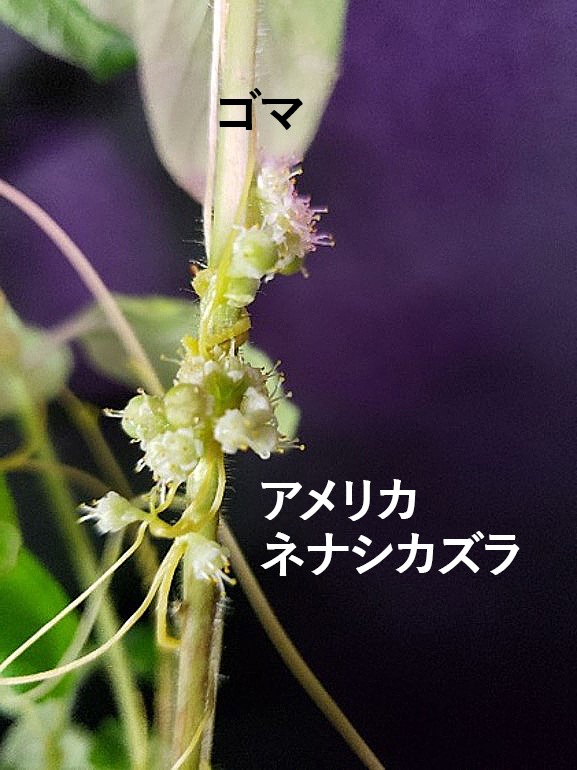
図1 ゴマに寄生するアメリカネナシカズラ
<関連情報>
- https://www.omu.ac.jp/info/research_news/entry-24824.html
- https://academic.oup.com/plphys/article/201/2/kiag335/8722230
トランスポゾンにコロニー化されたイントロンの獲得は、シトクロムP450遺伝子の寄生を介した水平伝達に続く Transposon-colonized intron gain follows parasitism-mediated horizontal transfer of a cytochrome P450 gene
Eiichiro Ono,Kohki Shimizu,Jun Murata,Tenta Segawa,Akira Shiraishi,Ryusuke Yokoyama,Hiromi Toyonaga,Masaki Takagawa,Manabu Horikawa,Atsushi Hoshino,…
Plant Physiology Published::30 June 2026
DOI:https://doi.org/10.1093/plphys/kiag335
Abstract
Specialized metabolites are often distributed sporadically across distantly related plant lineages, a pattern commonly attributed to convergent evolution, although the genomic processes enabling such innovation remain poorly understood. Here, we demonstrate that parasitic dodders (Cuscuta spp.) accumulate the lignan sesamin, a compound previously considered characteristic of sesame (Sesamum indicum) and related Lamiales species. We identified Cuscuta homologs of S. indicum CYP81Q1, which encodes piperitol/sesamin synthase (PSS), and demonstrated that these proteins retain catalytic PSS activity in vitro. Phylogenetic analyses indicate that CYP81Q was horizontally transferred from a Lamiales host to an ancestral Cuscuta lineage. Parasitism by C. campestris induces host CYP81Q expression and enhances interspecific transfer of genetic material across the haustorial interface, providing a mechanistic basis for horizontal gene transfer (HGT). Notably, comparative genomic analyses reveal that following horizontal acquisition, the transferred gene underwent extensive structural remodeling, characterized by sequential intron gains, while its enzymatic function was preserved. Many of the newly acquired introns exhibit hallmarks of insertion and excision of transposable elements, suggesting that mobile genetic elements contributed to post-transfer gene restructuring. The intron-rich architecture of Cuscuta CYP81Q was stably maintained throughout species diversification. Together, these findings suggest that parasitism-mediated HGT can be followed by intronization and transposon colonization, resulting in the generation of structurally complex yet functional genes. This process represents an underappreciated mechanism through which parasitic plants remodel horizontally acquired genes to facilitate metabolic innovation.