2026-07-15 東京科学大学
◆研究では、損失正接(tanδ)が1.8以下であることが構造安定性の指標となることを明らかにし、液体中で形成した微生物構造内で大腸菌が増殖し、酵素反応生成物が周囲へ拡散することを実証した。さらに、任意形状の二次元・三次元構造を安定して作製できることも示した。
◆本技術は、腸内細菌叢やバイオフィルムの空間構造を再現する新たなin vitroモデルとして、微生物間相互作用の解明、創薬、リビングマテリアルの開発などへの応用が期待される。研究成果はBiofabrication誌に掲載された。
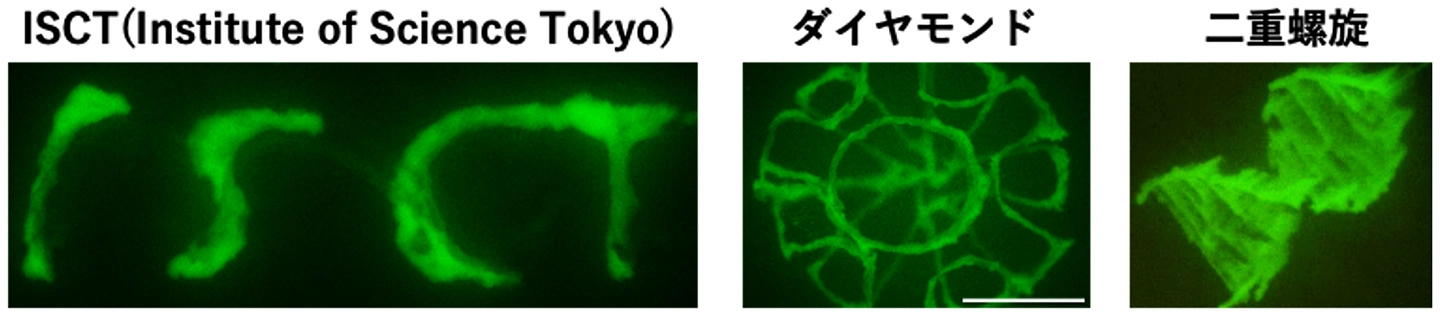
図1. 緑色蛍光タンパク質(GFP)発現大腸菌液により液体の中に描画した様々な3次元構造の蛍光観察画像
<関連情報>
- https://www.isct.ac.jp/ja/news/wduncqpgf7qc
- https://iopscience.iop.org/article/10.1088/1758-5090/ae7ed4
液体環境における浮遊物の形成:液体描画に基づく三次元微生物構造の作製 Floatony formation in liquid environments: liquid drawing-based fabrication of three-dimensional microbial structures
Hidetaka Taniguchi, Mai Miyauchi, Ippei Inoue and Masayoshi Tanaka
Biofabrication Published: 30 June 2026
DOI:10.1088/1758-5090/ae7ed4
Abstract
The spatial organization of microorganisms plays a pivotal role in regulating microbial physiology, community behavior, and ecological interactions. However, reconstructing such three-dimensional (3D) microbial architectures in vitro remains a major challenge because conventional culture systems rely on solid or gel-based matrices that restrict microbial motility and molecular diffusion. Here, we introduce ‘floatony’, a liquid-based strategy for the fabrication of spatially defined microbial colonies using liquid drawing technology. This approach enables the formation and retention of 3D microbial assemblies entirely within a liquid environment, without solidification or crosslinking. Using E. coli as a model organism, we examined how the rheological properties of the supporting liquid matrix influenced the stability of drawn structures of microbial assemblies. Although the optimal conditions depend on the molecular architecture of thickening agents, we identified an empirical design criterion—tanδ < 1.8—under which 3D structures of microbial assemblies were stably retained while maintaining low viscosity (∼10−1 Pa·s) conducive to efficient molecular diffusion. Enzymatic activity assays confirmed that E. coli maintained functional enzyme activity within the supporting liquid matrix, and that the diffusion of low-molecular-weight reaction products was preserved. Furthermore, complex two-dimensional and 3D structures of microbial assemblies were successfully fabricated and visualized in a liquid, including floating 3D structures, as confirmed by fluorescence imaging. This liquid drawing-based approach provides a new experimental framework for reconstructing and studying spatially organized microbial systems, offering opportunities for investigating microbial interactions and developing engineered living materials beyond conventional solid-supported platforms.