2026-07-16 京都大学
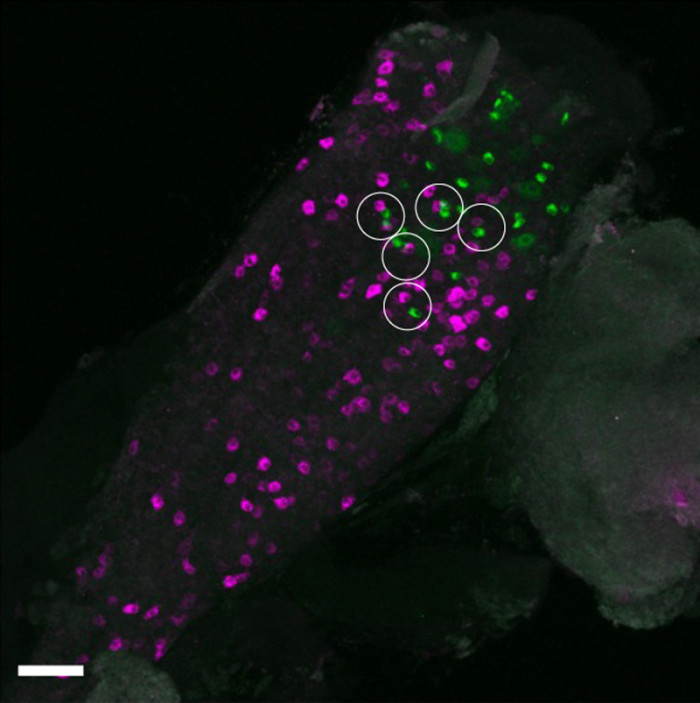
マウスの迷走神経節では、耳介皮膚へつながる感覚神経細胞(緑)と、肺へつながる感覚神経細胞(マゼンタ)が認められ、一部の細胞は互いに近接している(白丸)。作成・撮影者:渋谷倫太郎(Brian Kim研究室)
<関連情報>
- https://www.kyoto-u.ac.jp/ja/research-news/2026-07-16
- https://www.cell.com/immunity/fulltext/S1074-7613(26)00256-6
耳介迷走神経反射の活性化は気道炎症を抑制する Activation of the auricular vagus nerve reflex suppresses airway inflammation
Rintaro Shibuya ∙ Nobuya Abe ∙ Keaton Song ∙ … ∙ Kenji Kabashima ∙ Hongzhen Hu ∙ Brian S. Kim
Immunity Published:July 15, 2026
DOI:https://doi.org/10.1016/j.immuni.2026.06.005
Highlights
- Auricular skin contains TRPV1+ vagal sensory afferents
- Activation of these afferents suppresses allergic airway inflammation
- Vagal afferent-derived CGRPβ is necessary to suppress lung inflammation
- Auricular vagus nerve stimulation may represent a therapeutic modality
Summary
The vagus nerve regulates inflammation via sensory-motor arcs. While vagal sensory neurons relay signals from within the body (interoception), whether external inputs can regulate visceral neuroimmune responses (exteroception) remains poorly understood. We unveiled a skin-lung reflex by which sensory neurons from the auricular skin suppressed Alternaria alternata-induced allergic airway inflammation. Viral and chemical neural tracing revealed distinct sensory projections from the vagal ganglia to the auricular skin. Pharmacologic, chemogenetic, and optogenetic activation of auricular transient receptor potential vanilloid 1 (TRPV1)+ afferents attenuated type 2 allergic lung inflammation, including group 2 innate lymphoid cell, eosinophil, and type 2 cytokine responses in the airway. Conversely, silencing of these sensory neurons via the skin exacerbated lung inflammation, and immunosuppression of airway inflammation was dependent on the neuropeptide calcitonin gene-related peptide (CGRP)β. These findings reveal an evolutionarily conserved somato-visceral reflex by which exteroceptive inputs impact visceral inflammation. Thus, transcutaneous neuromodulation may represent a therapeutic strategy to treat visceral inflammation.