2026-07-16 京都大学
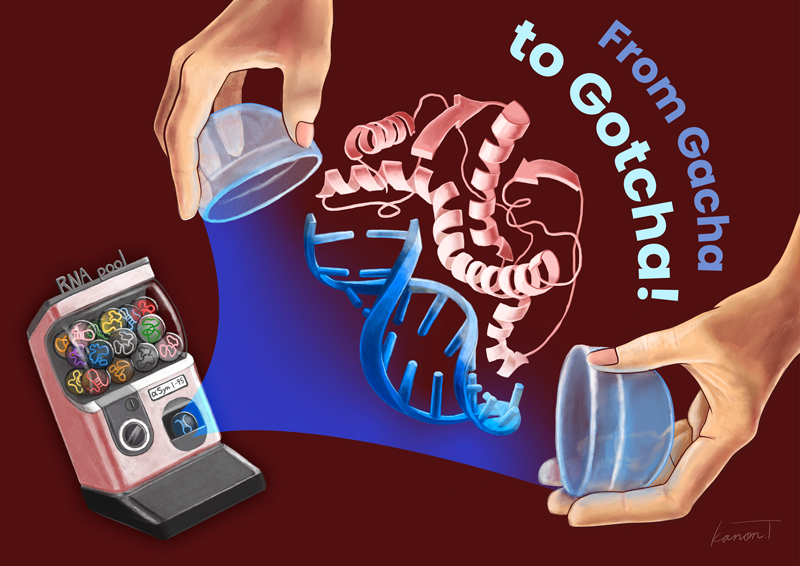
研究概念図(イラスト:Kanon Tanaka)
<関連情報>
- https://www.kyoto-u.ac.jp/ja/research-news/2026-07-16-1
- https://www.nature.com/articles/s41467-026-75209-z
シヌクレイン病の治療薬としてのRNAアプタマーの開発 Development of an RNA aptamer as a therapeutic agent for synucleinopathies
Kazuma Murakami,Thi Hong Van Nguyen,Leo Tsuda,Esha Chawla,Yangxia Wang,Yiran Chen,Nadia Stefanova,Chioko Nagao,Kenji Mizuguchi,Shouvik Manna,Samir K. Maji,Hidehito Tochio & Gal Bitan
Nature Communications Published:15 July 2026
DOI:https://doi.org/10.1038/s41467-026-75209-z Unedited version
Abstract
The aggregation of α-synuclein (αSyn), a 140-mer protein, has been implicated in the pathogenesis of Parkinson’s disease, multiple system atrophy, and dementia with Lewy bodies. KTKEGV pseudo-repeats (KRs) in the sequence of αSyn are key mediators of its prion-like propagation and neurodegeneration. Despite the availability of symptomatic treatments, no current therapy effectively delays disease progression. Here we report a 77-nucleotide RNA aptamer called 1R6, obtained through in vitro selection, that binds with high affinity and selectivity to αSyn1-95. 1R6 significantly inhibits αSyn oligomerization and β-sheet-rich fibril assembly and promotes disaggregation of preformed fibrils. Additionally, 1R6 suppresses αSyn seeding, as determined by a FRET-based biosensor-cell assay. Cellular studies reveal that 1R6 co-transfection completely prevents αSyn-induced cytotoxicity. To assess the protective effects of 1R6 in vivo, we use a Drosophila melanogaster model expressing human αSyn in neurons. Flies fed 1R6 show improved locomotor activity, reduced photoreceptor degeneration, and decreased αSyn levels in the head. Structural characterization using 1H-15N heteronuclear multiple quantum correlation nuclear magnetic resonance experiments demonstrates that 1R6 targets KR motifs, a finding further supported by in silico simulations. Our findings support further development of RNA aptamers, such as 1R6, including evaluation of efficacy, stability, delivery, and immune responses in mammalian systems, highlighting their potential as therapeutic candidates for synucleinopathies.