2026-07-21 北海道大学,札幌医科大学,酪農学園大学
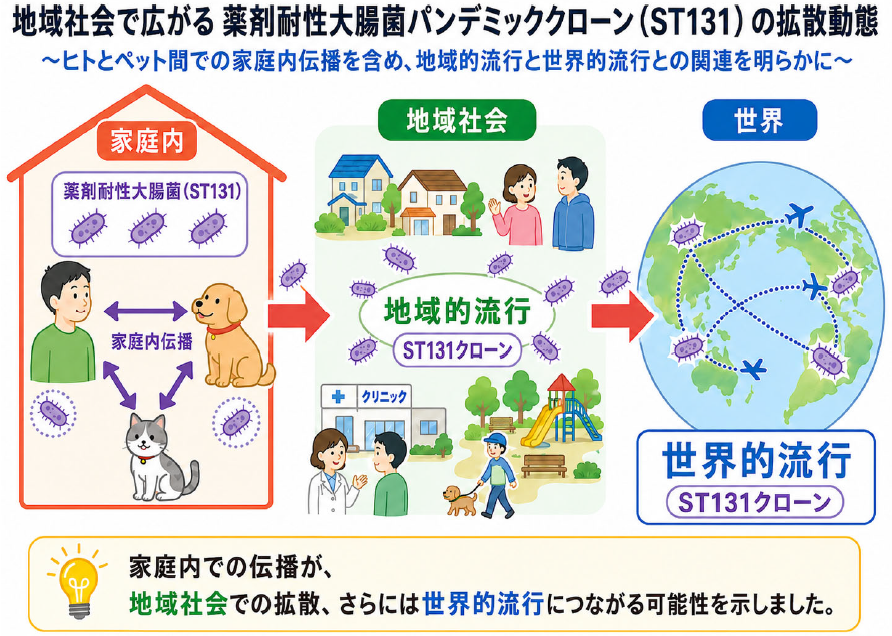
薬剤耐性大腸菌パンデミッククローンには、ヒトと伴侶動物を含めた家庭内・地域社会での拡散が寄与している知見が得られた。
<関連情報>
- https://www.hokudai.ac.jp/news/2026/07/post-2363.html
- https://journals.asm.org/doi/10.1128/aac.00007-26
地域社会を基盤としたOne Healthアプローチによる薬剤耐性大腸菌ST131の流行動態の解明 A community-based One Health approach to the pandemic dynamics of Escherichia coli ST131
Aiko Maeda, Toyotaka Sato, Akira Fukuda, Torahiko Okubo, Masaru Usui, Mana Tohyama, Jirachaya Toyting-Hiraishi, … , Motohiro Horiuchi
Antimicrobial Agents and Chemotherapy Published:23 June 2026
DOI:https://doi.org/10.1128/aac.00007-26
ABSTRACT
Large-scale genomic studies have advanced our understanding of the global dissemination of antimicrobial-resistant (AMR) bacteria, yet most have been limited by inconsistent sampling periods, heterogeneous geographic coverage, and weak epidemiological linkages among isolates. Consequently, the fine-scale processes underlying the establishment and maintenance of AMR pandemics remain unclear. To address these limitations, we established a rigorously controlled community- and household-integrated One Health framework that incorporates human, animal, and environmental reservoirs within a single urban area and unified sampling period, focusing on the pandemic fluoroquinolone-resistant (FQ-R) Escherichia coli sequence type (ST) 131. Using this model, we analyzed FQ-R E. coli isolates collected from humans, companion animals, sewage, and livestock in the Sapporo area, Japan, during 2021–2022. Among 2,358 E. coli isolates, 235 FQ-R isolates, including 88 ST131 isolates, underwent genomic analyses based on pan-, accessory-, and core genome data. These analyses revealed high clonal diversity but clear population structuring within ST131, with several subclusters shared between human and companion animal sources. High-resolution core genome SNP analysis delineated community-level transmission dynamics, demonstrating ST131 carriage among healthy humans and suggesting asymptomatic human-to-human spread and household-level human–companion animal transmission. These carriage isolates harbored multiple AMR genes and virulence factors and exhibited high genetic similarity to clinical isolates, indicating potential contributions to hospital-associated infections. Phylogenetic integration with international ST131 genomes demonstrated that transmission events in Sapporo are embedded within the broader global expansion of ST131. This study provides a scalable model for resolving local-to-global AMR dissemination and underscores the need for community- and household-level interventions within a One Health framework.