2026-07-22 東北大学
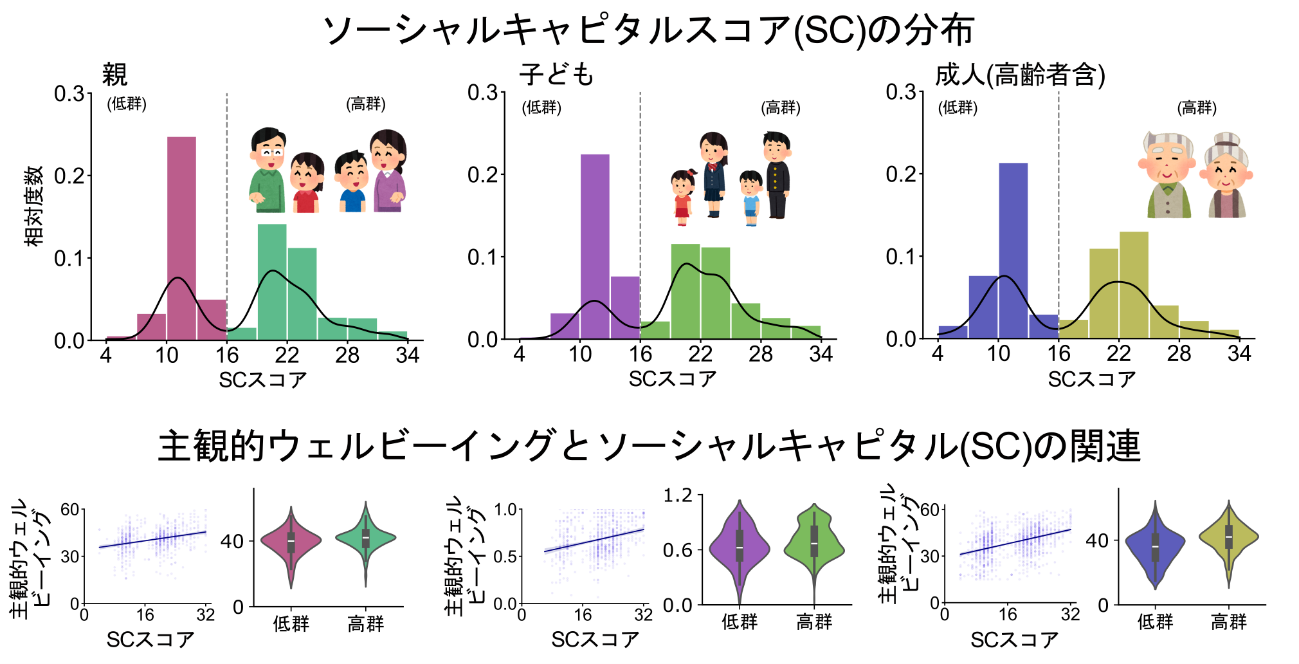
図1. ソーシャルキャピタルの分布と心理・親子関係との関連。
<関連情報>
- https://www.tohoku.ac.jp/japanese/2026/07/press20260722-01-bimodal.html
- https://www.nature.com/articles/s41598-026-60260-z
日本人集団における心理社会的プロファイルと脳ネットワークトポロジーに関連する二峰性社会資本 Bimodal social capital associated with psychosocial profiles and brain network topology in a Japanese population
Chihiro Hosoda,Takuto Matsuhashi,Sebastian Meguro,Chiu Tzu Tien,Zhou Zhi Yi & Kenchi Hosokawa
Scientific Reports Published:21 July 2026
DOI:https://doi.org/10.1038/s41598-026-60260-z
Abstract
Social capital (SC) is a key determinant of well-being and social participation, yet the magnitude of its individual differences and their neurobiological bases remain poorly understood. Here we showed that social capital (SC) is bimodally distributed across the lifespan and that these modes align with distinct psychosocial and neurobiological profiles. In a nationwide cross‑sectional survey in Japan (N = 2,574; ages 4–87) comprising 731 parent–child dyads and 1,112 adults without children, SC showed a reproducible two‑mode pattern. LASSO regression identified consistent psychosocial predictors of higher SC, including perspective-taking, empathy, and extraversion. In children, SC was strongly associated with parental SC (r = 0.40) and positive parent–child relationships, while parental income and education showed little explanatory value. In an independent neuroimaging cohort (N = 108), higher SC was linked to a more efficient structural covariance network, including greater small-world topology, higher hub centrality, and regional differences in cortical thickness and myelination across social brain regions (e.g., angular and supramarginal gyri, cingulate cortex, ventromedial prefrontal cortex). These findings demonstrate that, in this Japanese sample, SC was bimodally distributed, and each mode was associated with distinct psychosocial and neurobiological profiles, indicating divergent developmental pathways of social connectedness with implications for health and society.