2026-07-22 東京農工大学
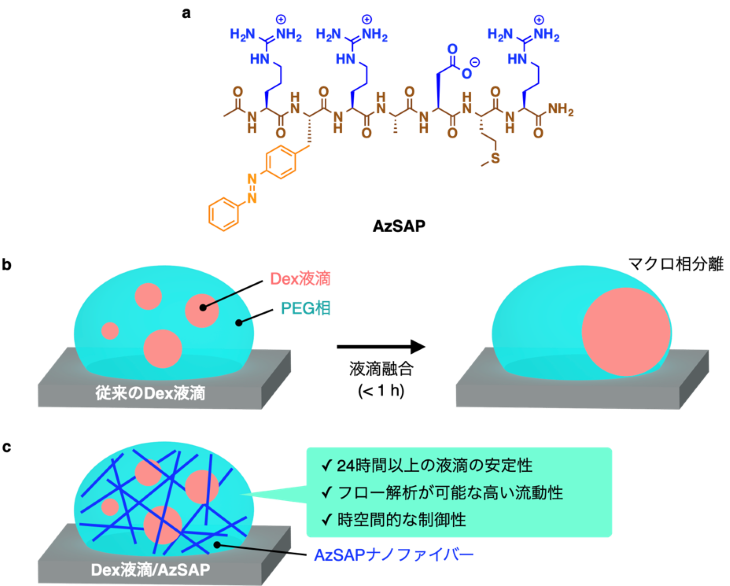
図1 (a) AzSAPの分子構造。(b,c) 不安定な従来のDex液滴(b)と、安定性、流動性、時空間的な制御性を兼ね備えたDex液滴/AzSAPシステム(c)の比較。
Dex/PEGのマイクロ液滴に対してAzSAPを添加すると、系中でナノファイバーを形成し、安定性、流動性、時空間制御性を持ったDex液滴が形成される。(図はNature Communicationsより改変)
<関連情報>
- https://www.tuat.ac.jp/outline/disclosure/pressrelease/2026/20260722_01.html
- https://www.nature.com/articles/s41467-026-75297-x#citeas
超分子ナノファイバーによる微小液滴の安定化により、超高感度なウイルス感染分析が可能になる Supramolecular nanofiber stabilization of microdroplets enables ultra-sensitive virus infection analysis
Noriyuki Uchida,Atsuya Yaguchi,Shiori Kondo,Kazuyoshi Muranishi,Haruka Kawabata,Haruka Umezawa,Naito Ishimoto,Michiko Tajiri,Satoko Akashi,Takuya Seki,Go Watanabe,Ayano Yoshida,Genki Higuchi,Jakuei Fu,Takanobu Takenouchi,Daisuke Yoshino,Hirotsugu Hiramatsu,Masaki Okumura,Tomohide Saio,Hiroyuki Noji,Young-Ho Lee,Sam-Yong Park & Takahiro Muraoka
Nature Communications Published:22 July 2026
DOI:https://doi.org/10.1038/s41467-026-75297-x
Abstract
Aqueous two-phase system (ATPS) droplets in cells act as fluidic microreactors by concentrating biomacromolecules. Inspired by this phenomenon, dextran-rich microdroplets formed in an ATPS with polyethylene glycol have been explored as artificial microreactors for sensitive detection and spatiotemporal control of biochemical reactions. However, the rapid fusion of the microdroplets into bulk phase separation has limited practical applications of this approach. Here, we report the stabilization of dextran-rich microdroplets using supramolecular nanofibers of an azobenzene-appending self-assembling peptide (AzSAP). Physicochemical characterization and structural analyses elucidate the mechanism of nanofiber formation and its role in droplet stabilization. The nanofiber network prevents droplet coalescence while maintaining macroscopic fluidity, thereby enabling highly sensitive quantitative virus detection via microfluidic analysis by confining infecting viruses within droplets. Furthermore, the photo-responsive properties of the AzSAP allow dynamic control over droplet size and intra-droplet virus activity, highlighting its exceptional potential as a platform for programmable artificial microreactors.