2026-09-02 ペンシルベニア州立大学(Penn State)
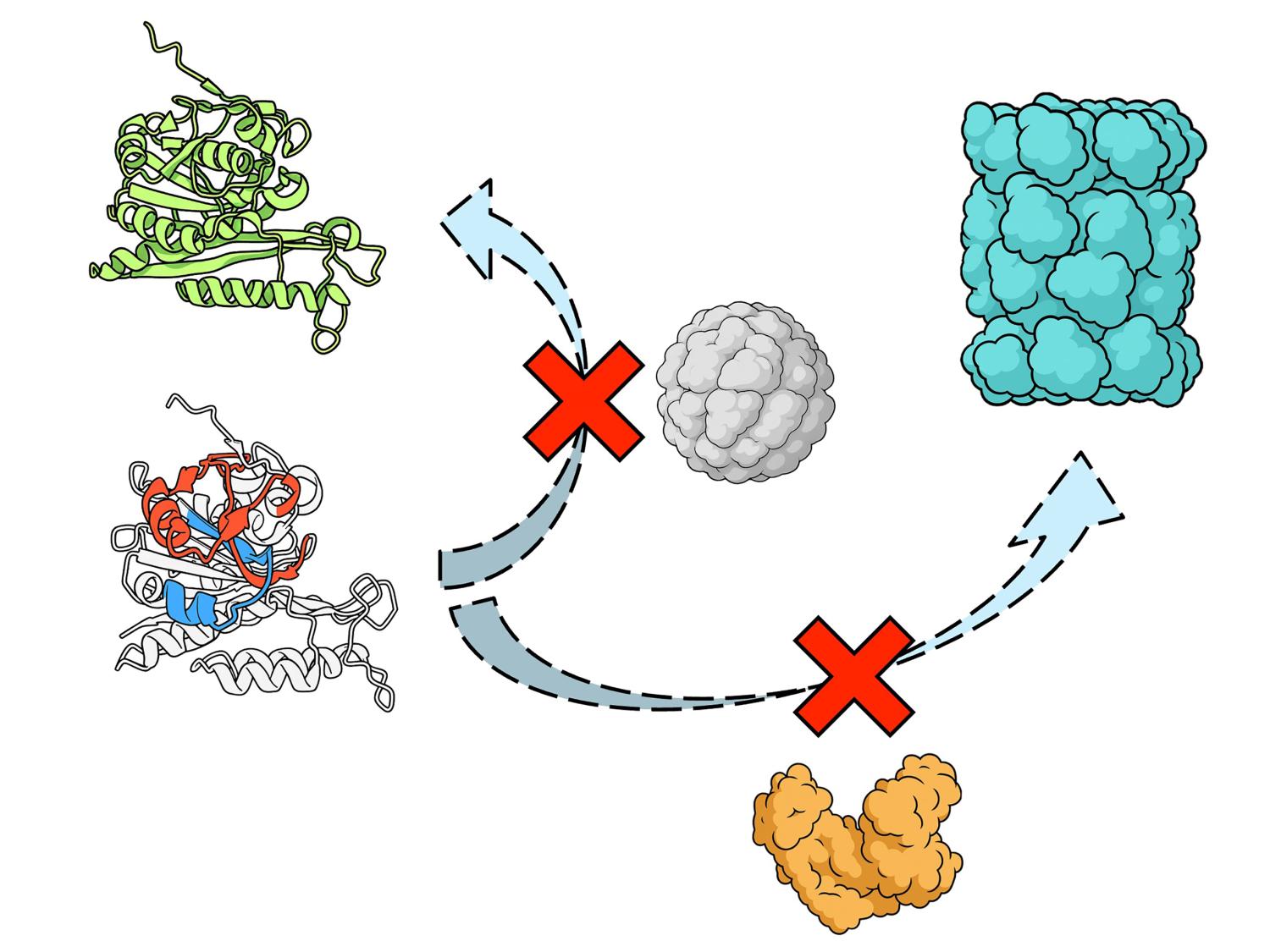
New research led by Penn State scientists has shown that proteins that contain a type of entanglement in their native structures are more likely to misfold, yet many of the misfolded proteins evade the cellular quality-control system. Credit: Yang Jiang / Penn State. Creative Commons
<関連情報>
- https://www.psu.edu/news/research/story/cellular-maintenance-crew-may-miss-much-half-certain-misfolded-proteins
- https://www.nature.com/articles/s41467-026-76875-9
タンパク質の絡み合いによるミスフォールディングは、タンパク質がプロテアソーム分解を受けるか、あるいはほぼ天然型のミスフォールディング状態のまま残存するかに影響を与える Protein entanglement misfolding influences whether proteins undergo proteasomal degradation or persist in near-native misfolded states
Yang Jiang,Anushka Jain,Sina Ghaemmaghami & Edward P. O’Brien
Nature Communications Published:25 August 2026
DOI:https://doi.org/10.1038/s41467-026-76875-9 Early provide
Abstract
A novel class of protein misfolding involving changes in entanglement status occurs across the bacterial cytosolic proteome and likely exists in many other organisms. Here, we test whether this class of misfolding has measurable consequences for protein homeostasis by examining its relationship with ubiquitin-mediated proteasomal degradation immediately after protein synthesis. Integrating protein structural information with ubiquitin mass spectrometry (Ubq-MS) data from human fibroblasts, we find that proteins containing native non-covalent lasso entanglements (NCLEs), which are known to be more prone to misfolding, are 93% (95% Confidence Interval: 44–160%) more likely to be ubiquitinated and targeted for proteasomal degradation than proteins lacking native entanglements. Coarse-grained folding simulations further show that ubiquitinated proteins with native entanglements are four-fold more likely to misfold than non-ubiquitinated proteins without entanglements. These results suggest that entanglement misfolding, primarily through failure to form native entanglements, increases susceptibility to proteasomal degradation. We further estimate that approximately one-third of the globular proteome populates near-native entanglement-misfolded states that evade proteasomal degradation because they remain structurally similar to the native ensemble. Given that entanglement misfolding is inherent to the polymeric nature of proteins, these findings are likely applicable across diverse organisms.