2026-07-22 東京科学大学
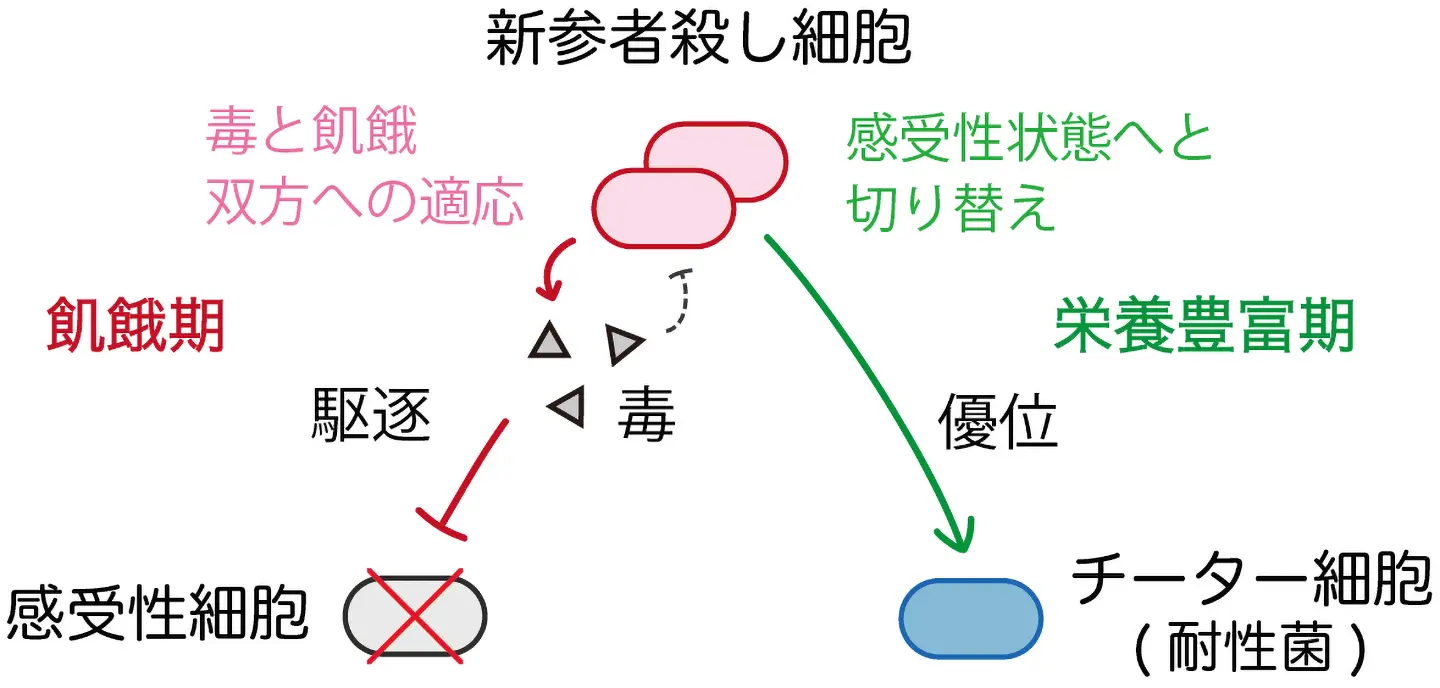
図1. 今回発見した新参者殺しを安定的に進化させる機構の模式図
<関連情報>
- https://www.isct.ac.jp/ja/news/siudycnb249b#top
- https://royalsocietypublishing.org/rsif/article/23/240/20260345/482558/Evolvability-of-the-toxin-adaptation-system-in
酵母における毒素適応システムの進化可能性 Evolvability of the toxin-adaptation system in yeast
Tetsuhiro S. Hatakeyama;Kunihiko Kaneko;Kunihiro Ohta;Arisa H. Oda
Journal of the Royal Society Interface Published:22 Jul 2026
DOI:https://doi.org/10.1098/rsif.2026.0345
Abstract
Crises such as starvation pose a serious threat to microbial populations, prompting cells to adopt survival strategies, such as cooperation or competition. Although cooperation among clones is common, recent studies have shown that yeast cells can kill clonal cells under glucose depletion by secreting autotoxins. Adapted cells survive, whereas non-adapted latecomers are eliminated. Remarkably, this toxin-adaptation (TA) system, which uses the same set of autotoxins, is conserved across distantly related yeast species. This is puzzling because conventional toxin-immunity (TI) systems are prone to exploitation by ‘cheaters’, cells that benefit from immunity without producing toxins, and typically diverge in an evolutionary arms race. To investigate how this system is maintained, we analysed its evolutionary stability using population dynamics modelling. The system does not evolve in constant environments: cheaters outcompete adaptive cells during continuous starvation, while sensitive cells that produce neither toxin nor immunity dominate in continuous nutrient-rich conditions. However, when the environment switches stochastically between starvation and nutrient-rich phases, with short starvation periods and long nutrient-rich periods, the TA system becomes evolutionarily stable. These findings suggest that fluctuating environments can promote the emergence and long-term maintenance of the TA system, highlighting the critical role of environmental switching in shaping microbial survival strategies.