2026-07-17 マサチューセッツ工科大学(MIT)
<関連情報>
- https://news.mit.edu/2026/how-influx-salt-may-affect-microbial-ecosystems-0717
- https://www.nature.com/articles/s41564-026-02422-3
- https://www.science.org/doi/10.1126/sciadv.ade8352
微生物種の構成における予測可能な変化は、環境ストレスに対するコミュニティ全体の強靭性につながる Predictable shifts in microbial species composition lead to community-wide robustness to environmental stress
Jana S. Huisman,Martina Dal Bello & Jeff Gore
Nature Microbiology Published:17 July 2026
DOI:https://doi.org/10.1038/s41564-026-02422-3
Abstract
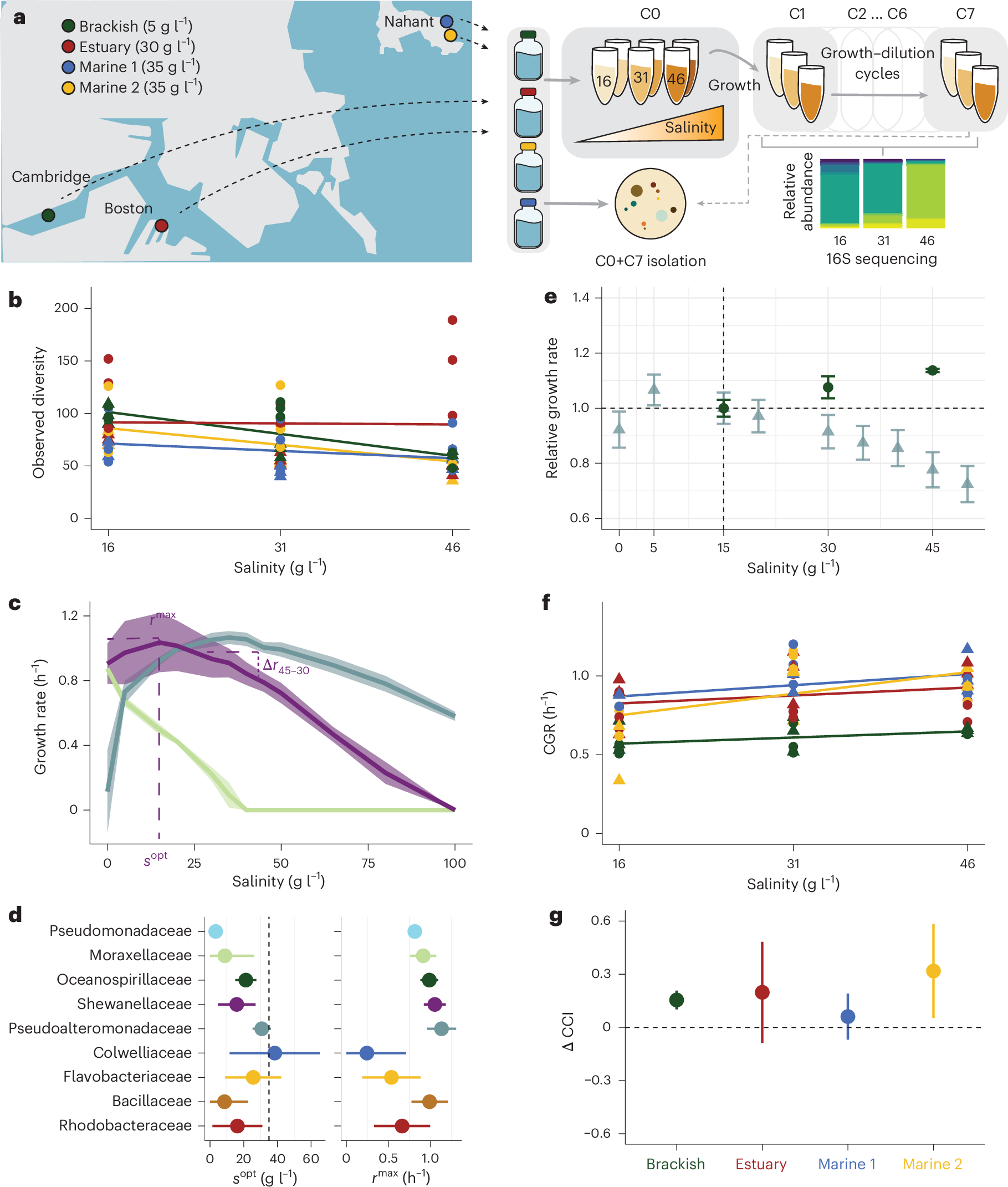
Environmental stress reduces species growth rates, but how it impacts microbial community function is less clear. Here we experimentally demonstrate that increasing salinity stress shifts community composition towards species with higher growth rates. This shift leads the mean community growth rate to be more robust to increasing stress than the growth of individual species. We demonstrate this by propagating natural aquatic communities at multiple salinities and mapping the observed diversity onto the measured salinity performance curves of more than 80 bacterial isolates. We validated these results with pairwise in vitro species competitions and using 16S data of microbial communities from estuarine environments. A generalized Lotka–Volterra model including mortality and salinity-dependent growth rates recapitulates the observed robustness of community growth sustained by more abundant faster growers at high salinity. These results could be extended to other environmental stressors, pointing to a fundamental mechanism with which communities maintain growth despite deteriorating conditions.
温暖な気温は、海洋生態系における成長の遅い細菌にとって有利に働く Warmer temperatures favor slower-growing bacteria in natural marine communities
Clare I. Abreu, Martina Dal Bello, Carina Bunse, Jarone Pinhassi, and Jeff Gore
Science Advances Published:10 May 2023
DOI:https://doi.org/10.1126/sciadv.ade8352
Abstract
Earth’s life-sustaining oceans harbor diverse bacterial communities that display varying composition across time and space. While particular patterns of variation have been linked to a range of factors, unifying rules are lacking, preventing the prediction of future changes. Here, analyzing the distribution of fast- and slow-growing bacteria in ocean datasets spanning seasons, latitude, and depth, we show that higher seawater temperatures universally favor slower-growing taxa, in agreement with theoretical predictions of how temperature-dependent growth rates differentially modulate the impact of mortality on species abundances. Changes in bacterial community structure promoted by temperature are independent of variations in nutrients along spatial and temporal gradients. Our results help explain why slow growers dominate at the ocean surface, during summer, and near the tropics and provide a framework to understand how bacterial communities will change in a warmer world.