2026-07-28 サセックス大学
<関連情報>
- https://www.sussex.ac.uk/broadcast/read/71063
- https://academic.oup.com/scan/article/21/1/nsag049/8728194
外国で危険にさらされている人や失われた人の数が増えるにつれて、神経反応が低下する Diminished neural responses for greater numbers of lives at risk and lives lost in foreign countries
Daniel Campbell-Meiklejohn,Jo Cutler
Social Cognitive and Affective Neuroscience Published:08 July 2026
DOI:https://doi.org/10.1093/scan/nsag049
Abstract
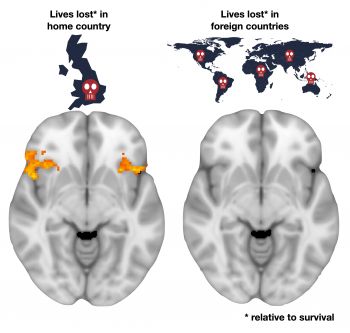
Humanitarian crises fail to elicit responses proportional to their scale. Two psychological factors that may contribute to this problem are scope insensitivity, where concern fails to increase proportionally with the number of lives at risk, and home country bias. We studied these factors with functional magnetic resonance imaging (fMRI) and behavioural measurement. Twenty-five participants completed scanning while viewing ‘headlines’: summaries describing a specified number (from one to tens of thousands) of lives that were at risk in either their home country or abroad, followed by information confirming their survival or death. Control trials presented analogous real financial risks. Whereas neural responses to financial risk scaled positively with risk magnitude, responses to life risk declined with larger numbers of lives at home and followed an ‘inverted-U’ in response to lives abroad: low for single lives abroad, higher for moderate numbers, but also low for the greatest numbers. Deaths only evoked stronger responses than survival for home country victims, in neural regions previously associated with emotion derived from harm coming to other people. Independent willingness to pay ratings also demonstrated both biases. This study provides neural characterizations of scope insensitivity and home country bias when learning about lives at risk.