2026-08-07 中国科学院(CAS)
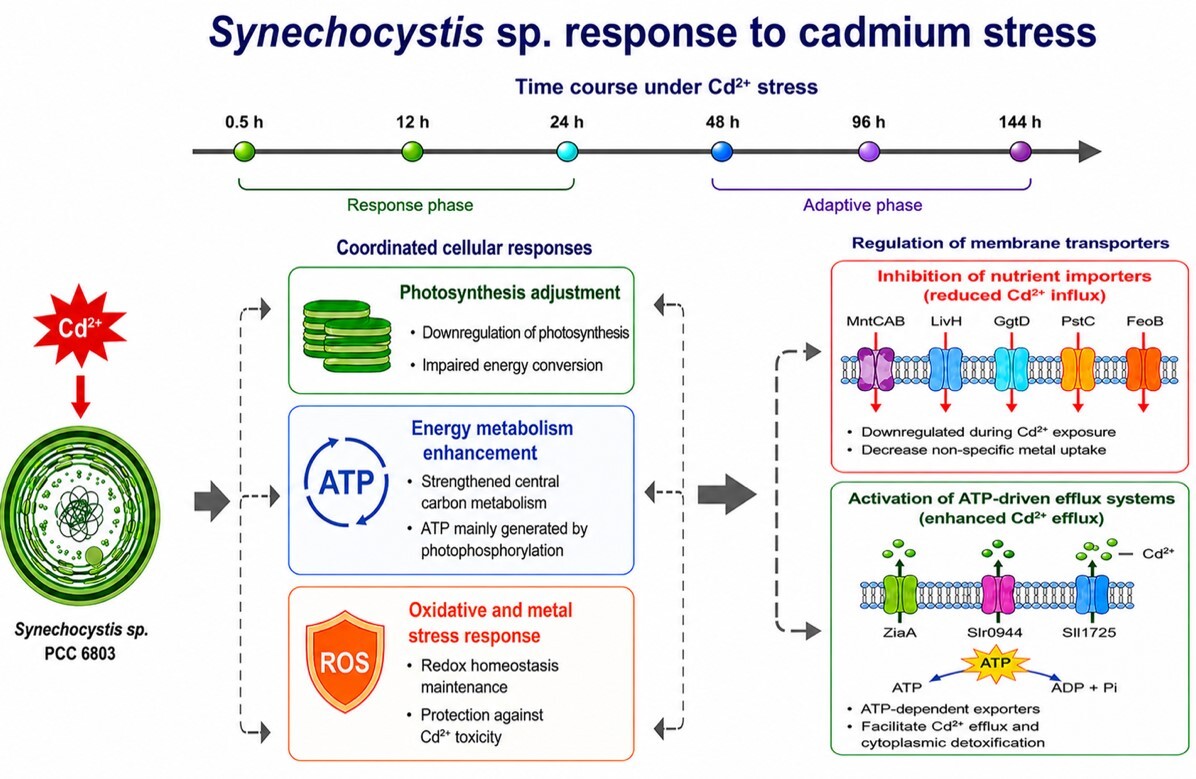
Schematic illustration of the two-stage response model of Synechocystis sp. PCC 6803 under low-level cadmium stress. (Image by IHB)
<関連情報>
- https://english.cas.cn/newsroom/research-news/202608/t20260810_1186977.shtml
- https://www.sciencedirect.com/science/article/abs/pii/S0269749126009607
時間分解マルチオミクスにより、Synechocystis sp. PCC 6803のカドミウムストレスに対する分子ダイナミクスが明らかになった Time-resolved multi-omics reveals molecular dynamics of Synechocystis sp. PCC 6803 to cadmium stress
Gang Ruan, Xiaohan Ai, Shaoqiang Sun, Jing Qian, Gaofei Song, Wujuan Mi, Dong Wan, Yonghong Bi
Environmental Pollution Available online: 18 June 2026
DOI:https://doi.org/10.1016/j.envpol.2026.128590
Highlights
- Cyanobacteria employ a biphasic molecular strategy.
- Temporal multi-omics reveals response-phase and adaptation-phase.
- Response phase activates cation efflux and glutamine synthetase.
- Adaptation phase dynamically regulates transporters and antioxidant enzymes.
Abstract
Cadmium pollution posed a serious threat to eco-environmental security, but molecular variation in microalgae induced by cadmium remains unknown. To address this, we screened the molecular dynamics in Synechocystis sp. PCC 6803 exposed to an environmentally relevant Cd2+ concentration (0.05 mg L−1) over 0–144 h. Differential express genes/proteins (DEGs/DEPs) and expression levels divided the exposure process into two stages. The response phase (0–24 h) was characterized by the rapid, transient, and highly specific gene/protein activation; the top uniquely DEGs/DEPs included nrsA (cation-efflux), PsbA1/T (Photosystem II protein) and Ssl1911 (glutamine synthetase) were defined as stage-specific molecular signatures. Their expression peaked before 24 h and showed no significant change thereafter. The adaptive phase (24–144 h) was characterized by the sustained and synergistic proteomic dynamic regulation, 145 co-expressed DEPs were identified, cadmium influx-associated transporters (MntCAB/FeoB) were suppressed, efflux systems (Slr0944/ZiaA) were induced coupled with enhanced central carbon metabolism (carbon fixation, oxidative phosphorylation, TCA cycle) and elevated antioxidant enzyme activity (Slr1516). It was concluded DEGs/DEPs involved in photosynthetic processes and antioxidant defense changed significantly within 24 h. These changes were followed by adaptive mechanisms, including down-regulating inward Cd2+ transporters while simultaneously up-regulating efflux pumps, as well as enhancing energy metabolism and antioxidant capacity. This dynamic pattern provided insight into the interaction between cyanobacterial cells and cadmium ions.