2026-08-12 ウィスコンシン大学マディソン校(UW-Madison)
<関連情報>
- https://news.wisc.edu/uw-researchers-simplify-production-of-promising-targeted-cancer-therapies/
- https://onlinelibrary.wiley.com/doi/full/10.1002/anie.202518579
- https://pubs.acs.org/acscii/article/7/3/499/873016/Development-of-Triantennary-N-Acetylgalactosamine
容易に入手可能なグリコシル供与体を用いたグリコシル部位特異的トランスグリコシル化による均一抗体複合体の効率的な調製 Efficient Preparation of Homogenous Antibody Conjugates via Glycosite-Specific Transglycosylation Enabled by Readily Available Glycosyl Donors
Dr. Deqin Cai, Yuan Zhao, Gaoyuan Lu, Dr. Chunrong Li, Yichong Lao, Dr. Ramesh Mudududdla, Jiahao Zhang, Peijing Jia, Penghsuan Huang, …
Angewandte Chemie Published: 04 January 2026
DOI:https://doi.org/10.1002/anie.202518579
Abstract
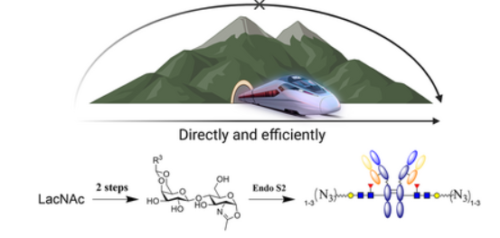
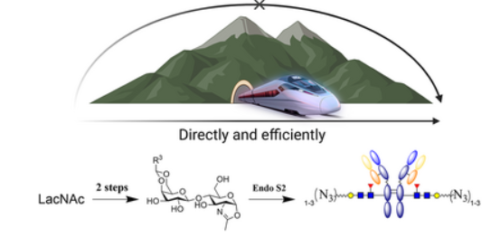
Site-specific antibody conjugation through glycoengineering offers a promising route to generate homogeneous glycosite-specific antibody‒drug conjugates (gsADCs) with improved therapeutic indices. Dozens of gsADCs are advancing from preclinical studies to clinical trials. However, current methods involve either multiple enzymes or lengthy preparation of substrates. Herein, we report a novel and synthetically streamlined platform utilizing LacNAc-derived 4,6-acetal glycosyl donors for glycosite-specific transglycosylation mediated by a single enzyme. These glycosyl donors can be synthesized in as few as two steps, representing a major advancement in synthetic accessibility compared to previously reported glycosyl donors, which often require more than 15 steps. Computational analysis showed that the acetal ring restricts conformation, directing donor 7 to a π–π-stabilized groove of the enzyme. Donor 7, along with a positive control, was evaluated in the context of gsADCs, consistently demonstrating potent and selective cytotoxicity toward HER2-positive cancer cells, while sparing HER2-negative cells. Furthermore, donor 7 was successfully adapted to generate glycosite-specific degrader-antibody conjugates (gsDACs), highlighting its broad utility. Additional studies revealed that donor 7 produces antibodies with markedly enhanced resistance to Endo S2 mediated hydrolysis. Together, these findings establish a practical and broadly applicable platform for glycosite-specific antibody conjugation, paving the way for next-generation antibody-based therapeutics.
細胞外タンパク質の分解剤としての三分岐N-アセチルガラクトサミン複合体の開発 Development of Triantennary N‑Acetylgalactosamine Conjugates as Degraders for Extracellular Proteins
Yaxian Zhou;Peng Teng;Nathan T. Montgomery;Xiaolei Li;Weiping Tang
ACS Central Science Published:March 04, 2021
DOI:https://doi.org/10.1021/acscentsci.1c00146
Abstract
Targeted protein degradation (TPD) technology has drawn significant attention from researchers in both academia and industry. It is rapidly evolved as a new therapeutic modality and also a useful chemical tool in selectively depleting various protein targets. As most efforts focus on cytosolic proteins using PROteolysis TArgeting Chimera (PROTAC), LYsosome TArgeting Chimera (LYTAC) recently emerged as a promising technology to deliver extracellular protein targets to lysosome for degradation through the cation-independent mannose-6-phosphate receptor (CI-M6PR). In this study, we exploited the potential of the asialoglycoprotein receptor (ASGPR), a lysosomal targeting receptor specifically expressed on liver cells, for the degradation of extracellular proteins including membrane proteins. The ligand of ASGPR, triantennary N-acetylgalactosamine (tri-GalNAc), was conjugated to biotin, antibodies, or fragments of antibodies to generate a new class of degraders. We demonstrated that the extracellular protein targets could be successfully internalized and delivered into lysosome for degradation in liver cell lines specifically by these degraders. This work will add a new dimension to TPD with cell type specificity.