2026-08-13 国立成育医療研究センター
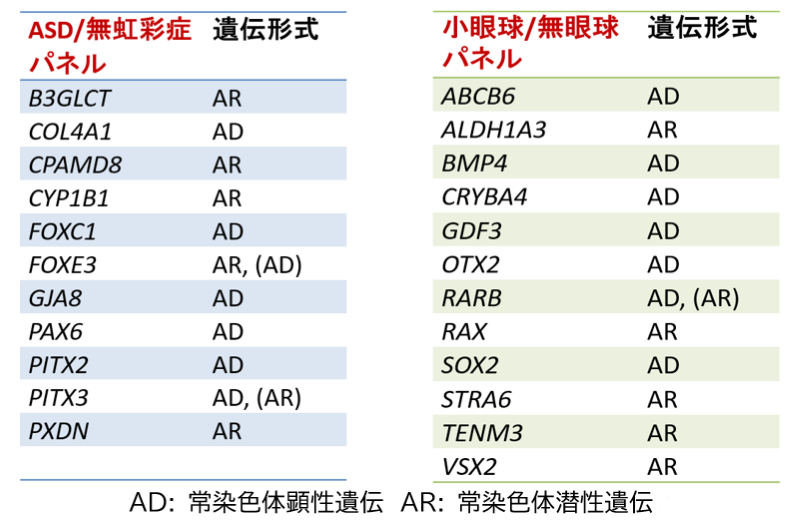
【表1:遺伝子パネル】
<関連情報>
- https://www.ncchd.go.jp/press/2026/0813.html
- https://www.ophthalmologyscience.org/article/S2666-9145(26)00277-0/fulltext
両側前眼部形成不全/無虹彩症および小眼球症/無眼球症患者111例の分子学的および臨床的解析 Molecular and Clinical Analyses of 111 Patients with Bilateral Anterior-Segment Dysgenesis/Aniridia and Microphthalmia/Anophthalmia
Sachiko Nishina, MD, PhD ∙ Hazuki Anzai, MD ∙ Tomoyo Yoshida, MD, PhD ∙ … ∙ Chie Sotozono, MD, PhD ∙ Keiko Matsubara, MD, PhD ∙ Maki Fukami, MD, PhD
Ophthalmology Science Published:July 28, 2026
DOI:https://doi.org/10.1016/j.xops.2026.101339
Abstract
Objective
To clarify the molecular and clinical characteristics of anterior-segment dysgenesis (ASD)/aniridia and microphthalmia/anophthalmia caused by monogenic variants.
Design
Clinical and genetic analyses of a large cohort of patients with bilateral ocular lesions.
Participants
A total of 111 patients and their family members were recruited through a multicenter collaborative study in Japan.
Methods
Next-generation sequencing using custom-designed panels for 11 and 12 major causative genes for ASD/aniridia and microphthalmia/anophthalmia, respectively. We analyzed the clinical information of patients with pathogenic or likely pathogenic variants.
Main Outcome Measures
Collated genetic results and clinical data.
Results
We achieved genetic diagnosis rates of 50.0% for ASD/aniridia and 37.5% for microphthalmia/anophthalmia. We identified 11 previously unreported variants. De novo variants in the PAX6, PITX2, or GJA8 genes, and parentally derived variants in the FOXC1 and CYP1B1 genes were the major causes of ASD/aniridia. Microphthalmia/anophthalmia-associated variants in the ABCB6, BMP4, and OTX2 genes were predominantly inherited from parents with no or different ocular phenotypes. We observed phenotypic diversity and variable ocular and systemic complications in variant-positive patients. Most importantly, this study showed a high incidence of glaucoma in patients with CYP1B1 and FOXC1 variants and frequent systemic abnormalities in patients with FOXC1 and PITX2 variants. In addition, BMP4 and RARB variants were associated with neurologic abnormalities.
Conclusions
This study provides evidence that targeted gene panel approaches are useful for the clinical diagnosis of ASD/aniridia and microphthalmia/anophthalmia. Our data clarified the mutation spectrum and phenotypic characteristics of these disorders caused by monogenic variants. This study confirmed that various phenotypes classified as ASD, such as Peters anomaly and Axenfeld anomaly, constitute a group of disorders on the same spectrum, may overlap with aniridia, and exhibit genetic heterogeneity. The findings, which demonstrate an association between genotypes and complications, are expected to contribute to better management and care for children with these rare intractable eye diseases.