2026-08-25 ジョージア大学(UGA)
<関連情報>
- https://research.uga.edu/news/blue-light-has-a-surprising-effect-on-your-eyes-study-finds/
- https://link.springer.com/article/10.3758/s13414-026-03244-5
人間の視覚における微細空間分解能の波長依存性 Wavelength dependence of fine spatial resolution in human vision
Yaw Buabeng & Billy R. Hammond
Attention, Perception, & Psychophysics Published:29 May 2026
DOI:https://doi.org/10.3758/s13414-026-03244-5
Abstract
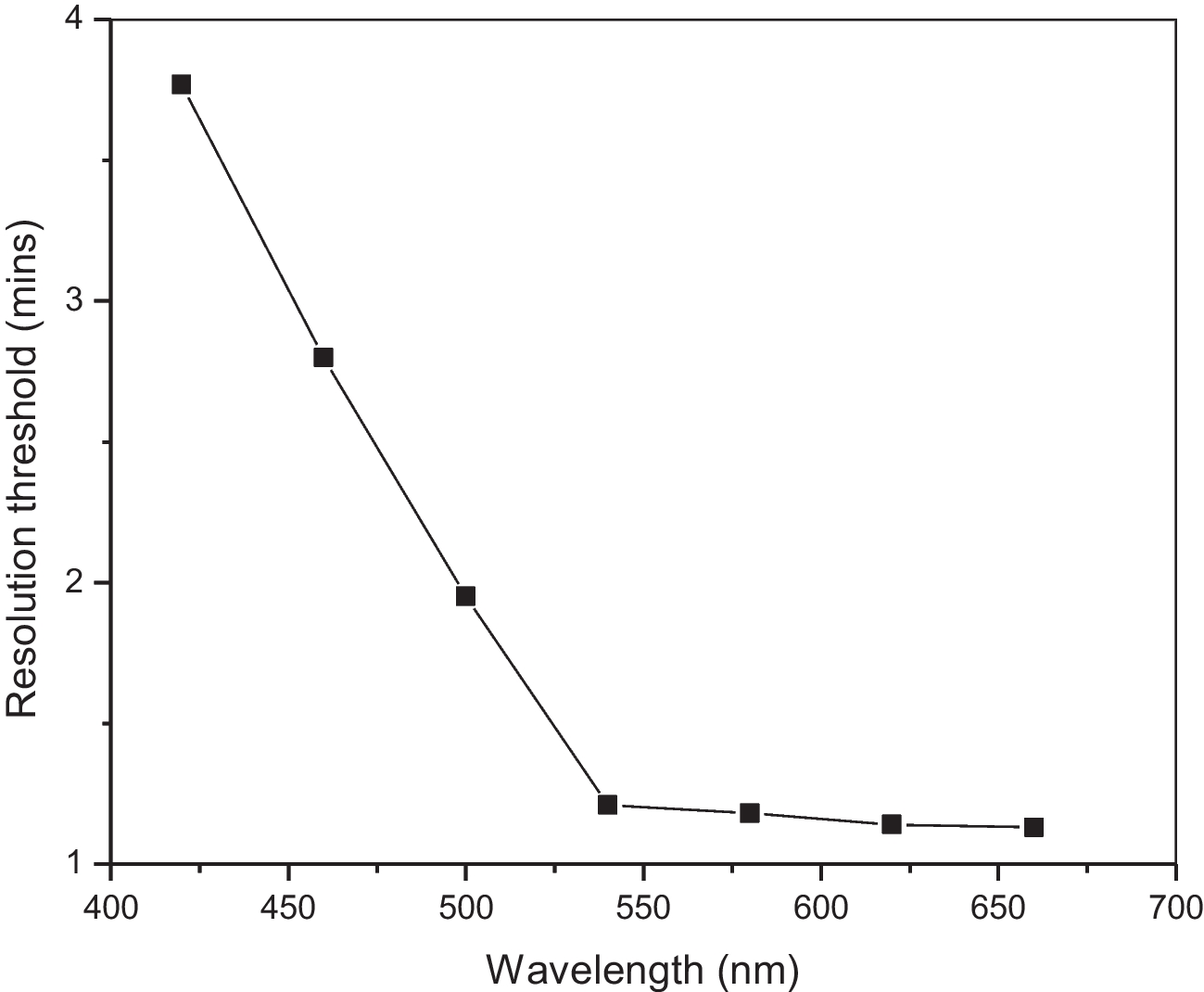
Wavelength influences multiple aspects of visual performance, yet its role in spatial resolution remains incompletely understood due to confounding factors such as luminance differences, chromatic aberration, and intraocular scatter. This study assessed how narrowband light of different wavelengths affects two-point separation thresholds under controlled stimulus and ocular conditions. Action spectra for fine spatial resolution were measured using an equal-energy approach. Sixty healthy young adults (mean age: 22.7 ± 3.3 years) with normal vision were tested in a two-point resolution task. Narrowband stimuli (420–660 nm) and a broadband white condition were produced by a 1,000-W Xenon arc lamp with interference filters. Participants were preselected for optimal acuity. Thresholds, defined as the minimum resolvable separation between two-point sources (two-point separation thresholds), were recorded using a digital micrometer, and converted to visual angle for analysis. Separation thresholds varied significantly with wavelength with short-wave light (420 nm) yielding poorer resolution compared to long-wave light (660 nm). Iris pigmentation (color, lightness, and a combination of color + lightness) also influenced performance with lighter irides associated with higher thresholds, and the largest group differences observed at short wavelengths. Two-point resolution shows systematic wavelength dependence under equal-energy conditions, with performance degraded in the short-wave range. These effects likely reflect the combined influence of chromatic aberration, optical scatter, and photoreceptor sampling, rather than scatter alone. Consideration of both optical and neural mechanisms is essential when interpreting wavelength-dependent changes in spatial vision.