2026-09-04 北海道大学
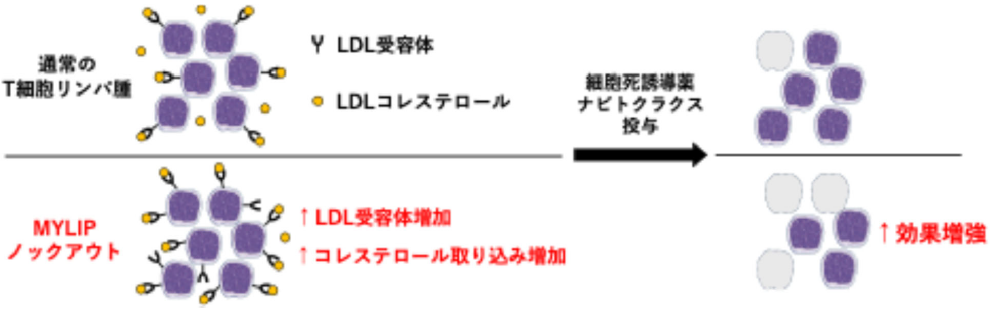
本研究結果の概要図
<関連情報>
- https://www.hokudai.ac.jp/news/2026/09/tmylipldlr.html
- https://www.nature.com/articles/s41388-026-03970-y
全ゲノムCRISPRスクリーニングにより、末梢性T細胞リンパ腫におけるBH3ミメティクス感受性を制御するRXR-MYLIP-LDLR経路を同定 Genome-wide CRISPR screens identify an RXR–MYLIP–LDLR axis regulating BH3 mimetic sensitivity in peripheral T-cell lymphomas
Keito Yokoyama,Masahiro Chiba,Norio Takei,Keito Suto,Takashi Ishio,Hideki Goto,Tomoyuki Endo,Marshall E. Kadin,Michiyuki Maeda,Masashi Watanabe,Shigetsugu Hatakeyama,Takanori Teshima,Yibin Yang & Masao Nakagawa
Oncogene Published:25 August 2026
DOI:https://doi.org/10.1038/s41388-026-03970-y
Abstract
BH3 mimetics are a promising class of drugs in hematologic malignancies, but their efficacy in peripheral T-cell lymphoma (PTCL) remains poorly understood. To identify genetic determinants of BH3 mimetic response, we performed a genome-wide CRISPR-Cas9 knockout screen in PTCL cell lines and identified MYLIP, an E3 ubiquitin ligase targeting the LDL receptor (LDLR), as a novel sensitizer to navitoclax. MYLIP deletion enhanced the cytotoxicity of navitoclax, venetoclax, and the BCL-XL–selective degrader DT2216 across multiple PTCL models. Mechanistically, MYLIP loss increased LDLR expression, promoted cholesterol uptake, and elevated apoptotic priming. Recombinant PCSK9, which facilitates LDLR degradation, reversed MYLIP knockout–induced sensitization, establishing a functional role for LDLR in BH3 mimetic response. We also identified the nuclear receptor RXRB as an upstream regulator of MYLIP; dual RXRA/RXRB depletion more effectively suppressed MYLIP, upregulated LDLR, and potentiated navitoclax cytotoxicity. In vivo, MYLIP-deficient xenografts showed enhanced tumor suppression with navitoclax treatment. Transcriptomic analyses of primary PTCL samples revealed reduced MYLIP expression in ALK-positive anaplastic large cell lymphoma and genetically defined subsets of nodal T follicular helper cell lymphomas. These findings uncover an RXR–MYLIP–LDLR axis that links cholesterol metabolism to apoptotic susceptibility, offering mechanistic insight into BH3 mimetic sensitivity in PTCL.