2026-08-05 メモリアル・スローン・ケタリングがんセンター(MSKCC)
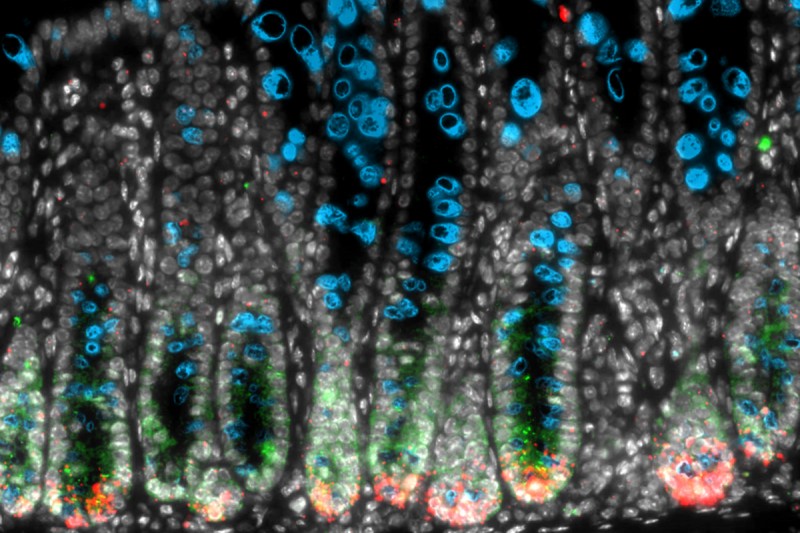
MSK researchers have identified the protein ZFP36L2 as a key regulator of normal gut renewal — a process hijacked by colorectal cancer cells to spread to new organs. Image: Ganesh Lab
<関連情報>
- https://www.mskcc.org/news/msk-scientists-find-molecular-switch-heals-gut-and-colorectal-cancer-hijacks-to-spread
- https://www.nature.com/articles/s41586-026-10890-0
ZFP36L2は再生と癌におけるストレス適応可塑性を制御する ZFP36L2 orchestrates stress-adaptive plasticity in regeneration and cancer
Qingwen Jiang,Manisha S. Raghavan,Aileen M. Rodriguez,Morgan Lallo,Cyrus L. Tam,Saskia Hartner,Britney Forsyth,Ahmed Mahmoud,Fabian Zincke,Huiyong Zhao,Andrew Moorman,Sasha Balkaran,Kathleen Luckett,Jura Pintar,Yevgeniy Romin,Eric Chan,Anthony Santella,Bernadette Mödl,Farheen Shah,Ilyes Baali,Michael G. Kharas,Elisa de Stanchina,Nil Urganci,Jinru Shia,… Karuna Ganesh
Nature Published:05 August 2026
DOI:https://doi.org/10.1038/s41586-026-10890-0
Abstract
Phenotypic plasticity is a hallmark of cancer1; however the molecular switches required for cell-fate reprogramming are poorly understood. During intestinal wound-healing and colorectal cancer (CRC) metastasis, differentiated cells can dynamically dedifferentiate into an intestinal stem cell (ISC) state to drive epithelial regeneration and metastatic outgrowth2,3,4,5,6,7,8,9,10. Here we show that the RNA-binding protein ZFP36L2, which is mutated in 5–10% of CRC11,12,13,14,15, is a pivotal stress-responsive orchestrator of dynamic dedifferentiation. In mouse colon regeneration models, ZFP36L2 ablation inhibits dedifferentiation, ISC gene expression and function and impairs intestinal regeneration. In human CRC, loss of ZFP36L2 function abrogates metastatic seeding and the outgrowth of LGR5+ canonical metastases while promoting lineage plasticity and non-canonical differentiation into heterogeneous cell states. Mechanistically, ZFP36L2 binds to stress-associated mRNAs that contain AU-rich 3′ untranslated regions, which induces the formation of dynamic biomolecular condensates associated with mRNA degradation and termination of the stress response. Together, these data show that ZFP36L2 acts as an important molecular switch that couples stress sensing with phenotypic plasticity. This in turn drives cellular dedifferentiation essential for re-establishing the ISC state during wound healing and metastasis. In ZFP36L2-deficient CRC, the inability to re-enter the LGR5+ state during metastatic outgrowth promotes non-canonical lineage plasticity, which is associated with poor clinical outcomes.