2026-09-10 ワシントン大学(UW)
<関連情報>
- https://www.washington.edu/news/2026/09/10/uw-wa-department-of-health-show-its-possible-to-test-wastewater-for-stis/
- https://pubs.acs.org/aewcaa/article/doi/10.1021/acsestwater.6c00486/5250418/Wastewater-Based-Epidemiology-of-Sexually
様々な規模における性感染症病原体の廃水疫学 Wastewater-Based Epidemiology of Sexually Transmitted Pathogens Across Scales
Angelo Q. Ong;Briahna Koger;Bradie Ahern;Megan E. O’Brien;Erika K. Keim;Erin Dahl;Piper Brase;Matthew Feck;Anna Berzkalns;Lisa Jones;Kirsten Duncan;Lianne Bradshaw;Nicole West;Lorenzo Giacani;Prakit Saingam;Mari K. H. Winkler;Breanna McArdle;Erica R. Fuhrmeister
ACS ES&T Water Published:August 07, 2026
DOI:https://doi.org/10.1021/acsestwater.6c00486
Abstract
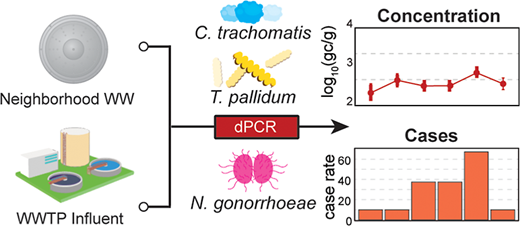
Wastewater-based epidemiology for sexually transmitted pathogens Chlamydia trachomatis (chlamydia), Neisseria gonorrhoeae (gonorrhea), and Treponema pallidum (syphilis) is sparse compared to viral targets despite their public health significance. We used multiplex, digital PCR to characterize C. trachomatis, Neisseria gonorrhoeae, and T. pallidum across multiple sewersheds and neighborhoods in Washington State, USA. We examined wastewater treatment plant (WWTP) influent from sewersheds that serve populations from less than 5000 people to over 100,000 people. To capture higher spatial resolution, we also sampled six neighborhoods within the city of Seattle. The most abundant pathogen, C. trachomatis was detected in 42–88% of samples across WWTP influent sites and between 13 and 80% of samples across Seattle neighborhoods. The concentration of C. trachomatis was highest in the smallest WWTP and neighborhood that contained a college campus. We observed potential underreporting of chlamydia cases across Seattle neighborhoods when comparing wastewater concentrations to case data. N. gonorrhoeae (NG) and T. pallidum (TP) were detected in few WWTP or neighborhood samples (NG 0–11% and TP 0–18% of WWTPs and neighborhood samples). We recommend considering the temporality of disease, disease burden, and demographics when identifying suitable sewersheds to monitor for STIs to maximize public health actionability.