
2026-09-14 京都大学
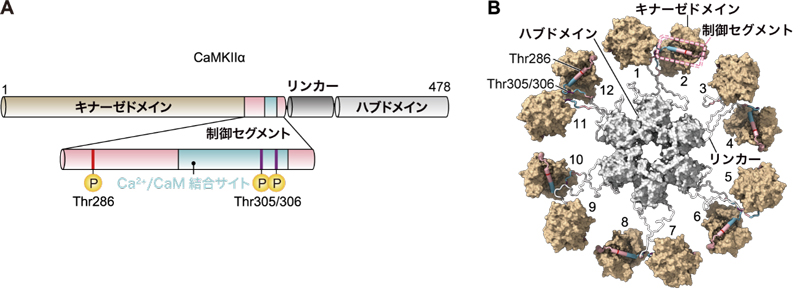
CaMKIIα のドメイン構成と12量体モデル
(A)CaMKIIαのサブユニット構成。キナーゼドメイン、制御セグメント、リンカー、ハブドメインからなる。数字はアミノ酸の位置を示す。(B)12個のサブユニットが中央のハブ集合体を囲んでリング状に組み上がった12量体のモデル(電子顕微鏡データに基づく)。自己リン酸化(P)を受けるThr286、Thr305、Thr306の位置を示す。
<関連情報>
- https://www.kyoto-u.ac.jp/ja/research-news/2026-09-14
- https://www.science.org/doi/10.1126/sciadv.aeg0958
CaMKIIα ホロ酵素はメゾスコピックな領域で鎖状のクラスターへと自己組織化する CaMKIIα holoenzymes self-organize into chain-like mesoscale clusters
Taisei Suzuki, Takashi Sumikama, Keisuke Matsushima, Kodai Hasegawa, […] , and Mikihiro Shibata
Science Advances Published:11 Sep 2026
DOI:https://doi.org/10.1126/sciadv.aeg0958
Abstract
Calcium- and calmodulin-dependent protein kinase II (CaMKII) is highly enriched in dendritic spines at concentrations comparable to those of cytoskeletal proteins and plays a central role in synaptic plasticity. During long-term potentiation, CaMKIIα further accumulates in spines. However, the mechanisms governing its higher-order organization remain poorly understood. Here, we use high-speed atomic force microscopy to visualize interholoenzyme interaction of CaMKIIα at mesoscopic scales (5 to 500 nanometers). Under freely diffusible conditions, CaMKIIα holoenzymes do not form stable clusters. In contrast, when spatially confined, they assemble into chain-like clusters mediated by kinase-domain interactions. These clusters expand upon activation, concomitant with the dissociation of the regulatory segment. Notably, the CaMKIIα Pro212→Leu (P212L) mutant associated with neurodevelopmental disorders forms extensive clusters even in the basal state. Together, our findings demonstrate that CaMKIIα-CaMKIIα interactions drive mesoscale cluster formation and that precise regulation of cluster size and activation-dependent growth might be critical for synaptic signaling.

