2026-09-21 スタンフォード大学
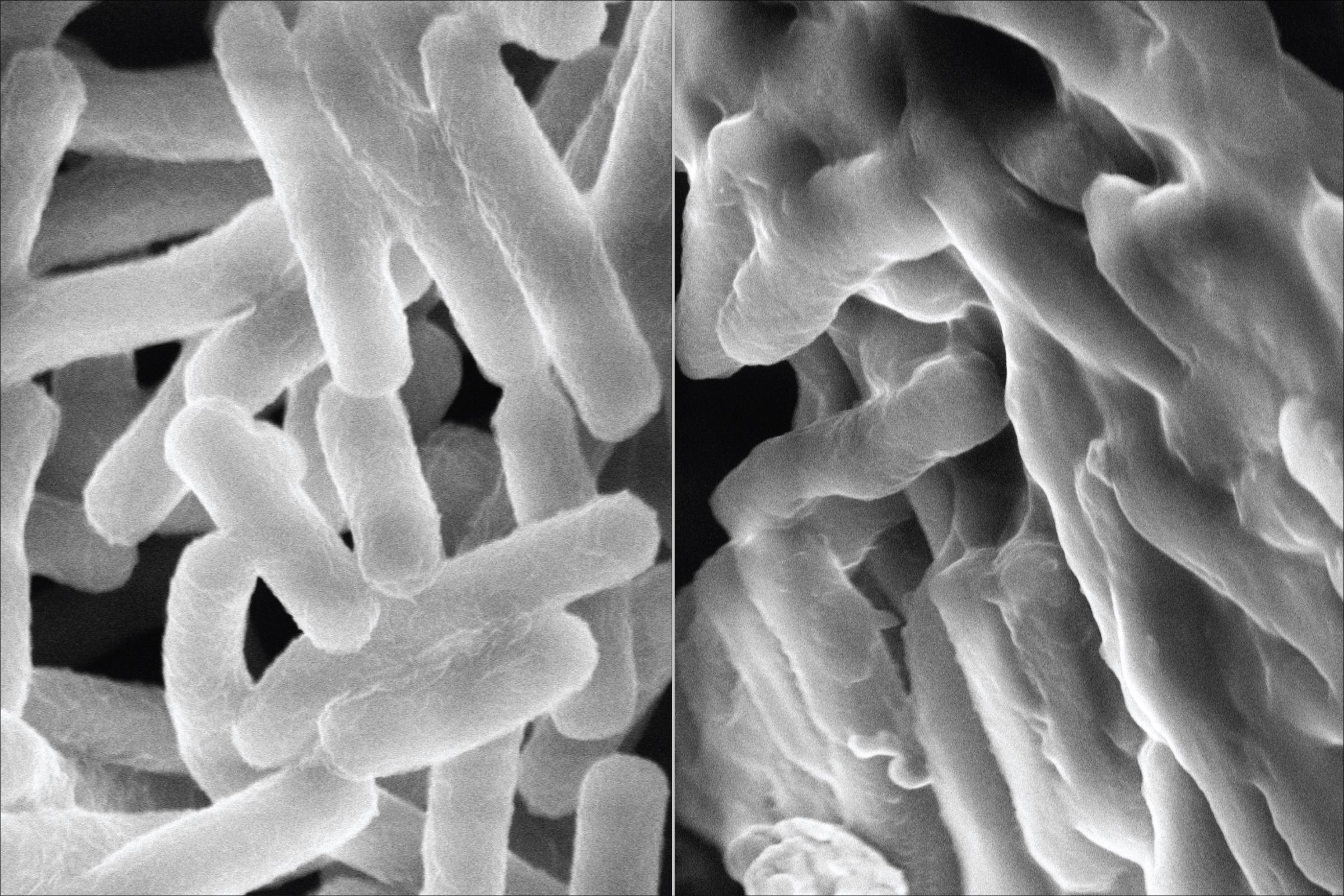
Left: Unperturbed bacteria. Right: Bacteria exhibiting damaged cell membranes after treatment with an antimicrobial polymer. | Changxin Dong and Shoshana Williams
<関連情報>
- https://news.stanford.edu/stories/2026/09/bacteria-killing-polymers-new-class-antibiotics
- https://www.cell.com/matter/abstract/S2590-2385(26)00389-9
抗菌性ポリアクリルアミドの発見のための分子間アクティブラーニング Cross-molecular active learning for the discovery of antimicrobial polyacrylamides
Shoshana C. Williams ∙ Anna Makar-Limanov ∙ Gabriel Greenstein ∙ … ∙ Lynette Cegelski ∙ Hector Lopez Hernandez ∙ Eric A. Appel
Matter Published:September 21, 2026
DOI:https://doi.org/10.1016/j.matt.2026.103026
Highlights
- Cross-molecular machine learning enables identification of antimicrobial polymers
- Predicted antimicrobial polymers show favorable safety profiles
- Predicted antimicrobial polymers show broad-spectrum antimicrobial efficacy
- One candidate shows antibiofilm efficacy and synergizes with existing antibiotics
Summary
Antimicrobial resistance poses an urgent threat to global health. The development of new antimicrobials is crucial. Synthetic copolymers are attractive as a potential tool because they can be produced at scale and designed to mimic antimicrobial peptides and act as broad-spectrum antimicrobials capable of evading resistance mechanisms. This work leverages a cross-molecular machine learning pipeline, trained on antimicrobial peptides, to develop potent antimicrobial polymers—which were then synthesized and validated experimentally—to combat Escherichia coli. Crucially, all polymers predicted by the active learning pipeline during exploitation sampling exhibited impressive antimicrobial activity. One candidate copolymer was further characterized and shown to permeabilize the bacterial membrane, which is associated with decreased resistance. Furthermore, this copolymer demonstrated remarkable synergy in eradicating biofilm-associated E. coli when combined with a clinical drug regimen. These results demonstrate promise for potentiating antibacterial activity of currently available antibiotics, treating serious and complicated infections, and combatting antimicrobial resistance.