2026-09-24 京都大学
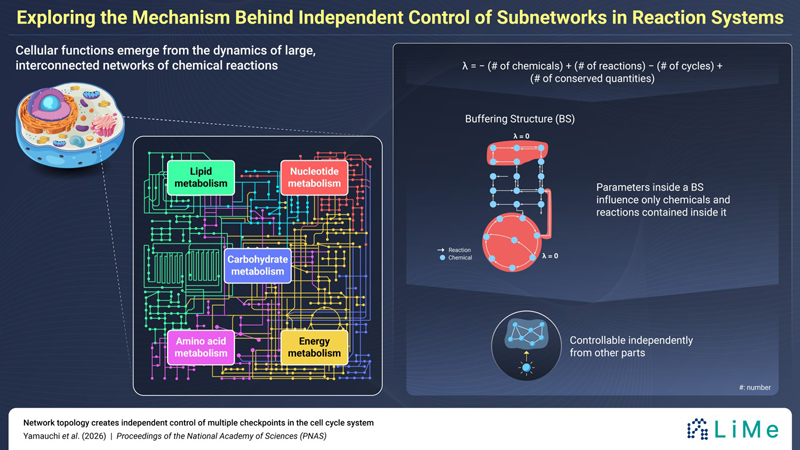
研究全体の概念図
<関連情報>
- https://www.kyoto-u.ac.jp/ja/research-news/2026-09-24-1
- https://www.pnas.org/doi/10.1073/pnas.2537815123
ネットワークトポロジーが細胞周期システムにおける複数のチェックポイントの独⽴した制御を⽣み出す Network topology creates independent control of multiple checkpoints in the cell cycle system
Yuhei Yamauchi, Hironori Sugiyama, Yuhei Goto, +1 , and Atsushi Mochizuki
Proceedings of the National Academy of Sciences Published:September 23, 2026
DOI:https://doi.org/10.1073/pnas.2537815123
Abstract
In living cells, numerous chemical reactions are interconnected by sharing substrates and products, forming a huge reaction network. The various functions of cells emerge from the dynamics of such interconnected system. Cells regulate the concentrations of key biochemicals by controlling the amount or activity of enzymes that catalyze each reaction, thereby achieving control of cellular functions. However, in such an interconnected system, can different chemicals responsible for different biological functions be controlled independently? If so, by what mechanism? This paper mathematically demonstrates that “modularity,” where parts of a system are controlled independently of others, arises solely from network topology. Furthermore, using the cell cycle system as an example, we show through a combination of theory and experiments that such “regulatory modules” actually exist in living organisms, performing important roles. In the cell cycle, the G1-S and G2-M transitions are strictly controlled by distinct protein complexes, requiring the specific activation of different complexes at different phases. This suggests that different transitions should be independently controlled. However, two cell-cycle-control complexes share a common protein component, raising the question of how phase-specific control is achieved. Analysis of a known cell cycle network using a topology-based theory revealed that the two complexes belong to different regulatory modules. Experimental verification confirms the existence of a module. Moreover, by comparing theoretical predictions with experimental verification, we theoretically predict the necessity of an unknown reaction and experimentally confirm it. This prediction and verification approach using model-free theory enables the updating of the network information.