2026-10-16 国立精神・神経医療研究センター
<関連情報>
- https://www.ncnp.go.jp/topics/detail.php?@uid=GuqAMrLNHwz8heWV
- https://onlinelibrary.wiley.com/doi/10.1002/epi.70514
mTOR関連てんかんの包括的なトランスクリプトームおよびプロテオーム解析 Comprehensive transcriptomic and proteomic profiling of mTOR-related epilepsy
Kaiyuan Ji, Satoshi Miyashita, Keiya Iijima, Kaoru Yagita, Tomoo Owa, Kazumi Shimaoka, Nao K. N. Tabe, Minami Mizuno, Ayane Hosaka, Kayo Nishitani, …
Epilepsia Published: 12 October 2026
DOI:https://doi.org/10.1002/epi.70514
Abstract
Objective
Malformations of cortical development (MCDs) are a major cause of drug-resistant epilepsy (DRE) in children. A subset of MCDs, including focal cortical dysplasia type II, tuberous sclerosis complex, and hemimegalencephaly, shares characteristic histopathological features and somatic mutations in genes within the Phosphoinositide 3-kinase (PI3K)–AKT–mechanistic target of rapamycin (mTOR) signaling cascade, and is collectively termed mTORopathies. However, mechanisms driving epileptogenesis and drug-resistant seizures remain poorly understood.
Methods
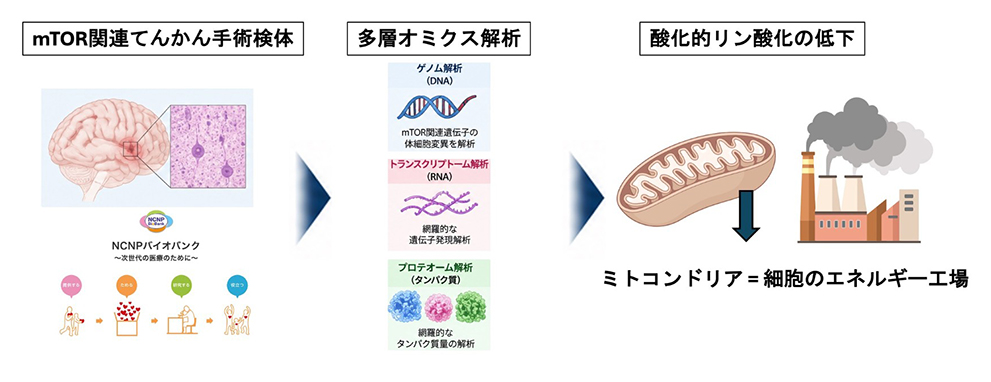
We performed integrated genomic, transcriptomic, and proteomic analyses of 56 surgical brain specimens from 41 patients with MCDs and 15 with mesial temporal lobe epilepsy. Targeted genomic sequencing identified 19 somatic mutations in PI3K–AKT–mTOR pathway genes, including novel variants in AKT3 (L51H) and MTOR (A512T).
Results
RNA sequencing with independent cohort comparison identified 160 consistently differentially expressed genes. Downregulated genes were enriched in oxidative phosphorylation (OXPHOS) and mitochondrial metabolic pathways, whereas upregulated genes were associated with developmental process. Proteomic analysis revealed directionally concordant reductions in several mitochondrial proteins, and pathway-level alterations in some biological cellular processes.
Significance
This study provides a patient-matched, multi-omics dataset of human mTOR-related epilepsies from a single-institution cohort. Integrated transcriptomic and proteomic analyses suggested impaired OXPHOS as a molecular hallmark, potentially contributing to focal hypometabolism in mTOR-related epilepsy. These findings offer mechanistic insights into epileptogenesis and provide a resource for understanding molecular pathologies and developing mechanism-based therapies for mTOR-related epilepsy.