2026-10-22 イェール大学
<関連情報>
- https://news.yale.edu/2026/10/22/public-health-programs-can-rewire-social-networks-yale-study-finds
- https://www.nature.com/articles/s41586-026-11154-7
教育的介入は村の社会ネットワークを再構築することができる Educational intervention can rewire village social networks
Marios Papamichalis, Laura Forastiere, Edoardo M. Airoldi & Nicholas A. Christakis
Nature Published:14 October 2026
DOI:https://doi.org/10.1038/s41586-026-11154-7
Abstract
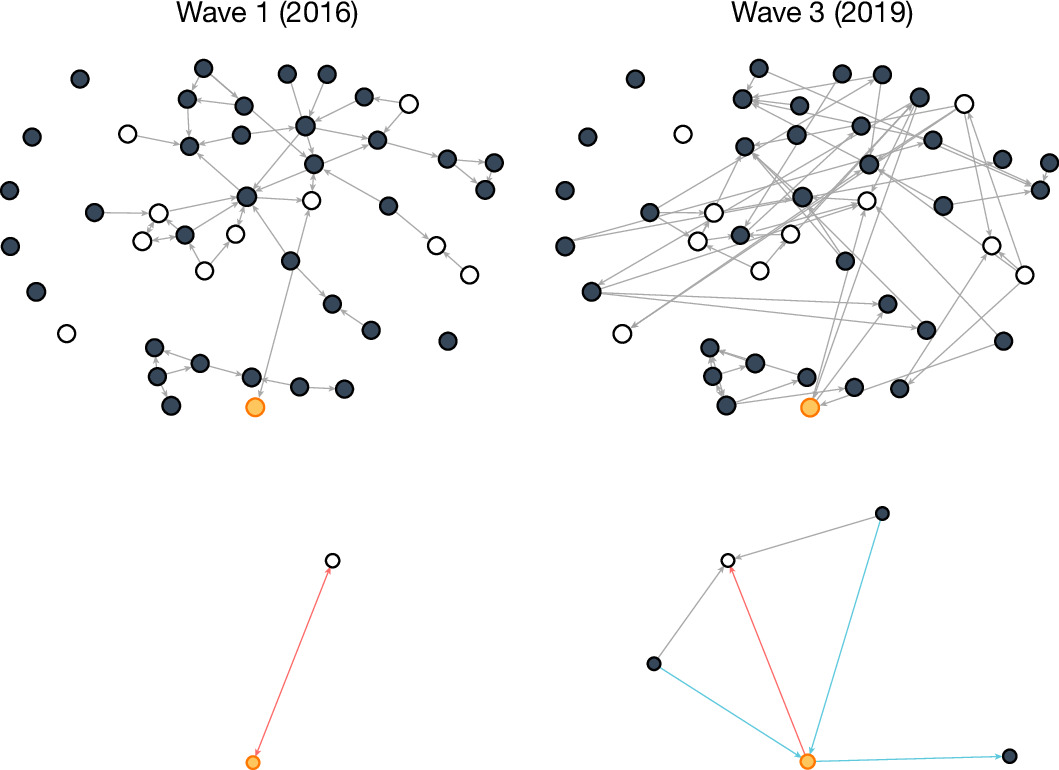
Social networks shape behaviour, affect information dissemination and undergird collective action. And they can be exploited in the design of interventions in these domains1,2,3,4,5,6,7. Although social networks obey fundamental principles, such as the degree distribution8,9, they can nevertheless evolve as ties form and break. Here, through a randomized controlled trial involving a total of 8,331 people in 110 remote Honduran villages, we evaluate the secondary effects of a 22-month public-health intervention1 on pre-existing social-network structure. We used a design in which a varying fraction of village households received the intervention, and villages in which no one received the intervention were used as the primary reference group. In ‘low-dosage’ villages (in which 5–30% of households received the intervention), people who received the intervention tended to sever ties with untreated individuals to whom they previously went for health advice. Conversely, in high-dosage villages (50–100%), treated individuals increased their ties. These average changes are explained mainly by tie dynamics; that is, treated–treated pairs persist and form new links, whereas treated–untreated ties dissolve. A mediation analysis indicates that absorption of health information increases the likelihood of tie formation and persistence. The rewiring patterns generally lasted for three years after the intervention ceased. Moreover, although the intervention delivered health information, it reshaped friendship and financial ties, not just health-advice connections. In aggregate, the introduction of a new information regime acted as a kind of social institution, rewiring individuals’ connections even though the overall degree distribution of village-wide networks remained relatively stable.