2026-10-26 マサチューセッツ工科大学(MIT)
米国マサチューセッツ工科大学(MIT)の研究チームは、超音波を利用して脳内での薬剤の拡散範囲を広げる埋め込み型デバイス「LUCID」を開発した。脳腫瘍の一種である膠芽腫は、手術で腫瘍を切除しても残存がん細胞によって再発することが多く、周囲の脳組織へ薬剤を十分に届ける技術が課題となっている。LUCIDは、薬剤を注入する流路と24個の小型超音波振動子を一体化し、浸透圧ポンプによる持続的な薬剤注入と、無線制御による超音波照射を組み合わせた。超音波が生み出す流れによって薬剤の移動を促進するとともに、血液脳関門の透過性を一時的に高めることを狙う。組織を模したゲルでの実験では、超音波を併用することで薬剤分子の拡散範囲が拡大した。また、マウスの脳内にMRI造影剤を投与する実験でも、超音波照射による分布範囲の拡大が確認された。将来的には、膠芽腫の再発予防に加え、免疫療法薬や遺伝子治療薬の局所投与への応用が期待される。現段階では前臨床研究であり、ヒトでの有効性・安全性の検証が必要である。
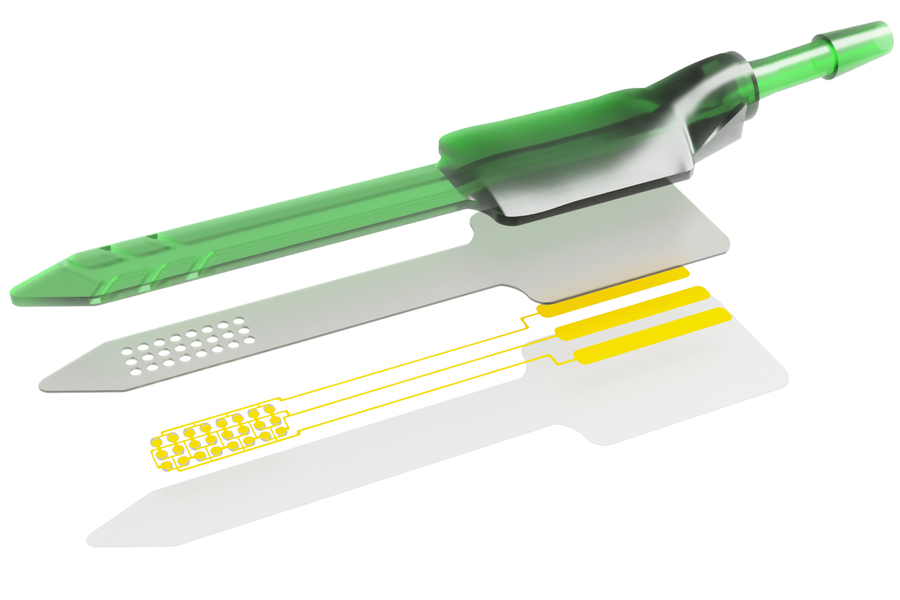
An illustration shows how LUCID combines a 3D-printed fluid-delivery channel with a layered miniature ultrasound array. This integrated structure brings ultrasound generation and local infusion together in a single device. Components are separated for illustration. Credit: Courtesy of the researchers
<関連情報>
神経系への薬物送達のための超音波増強型長期対流注入装置
Long-term ultrasound-enhanced convective injection device for neural drug delivery
Jason F. Hou, ∙ Sarah B. Ornellas, ∙ Michal O. Nowicki ∙ … ∙ Steve Ramirez ∙ E. Antonio Chiocca ∙ Canan Dagdeviren
Device Published:October 26, 2026
DOI:https://doi.org/10.1016/j.device.2026.101333
Highlights
•A 24-element ultrasound array integrates with a printed neural-delivery cannula
•Wireless power and control support a 20-h phantom delivery experiment
•Ultrasound roughly doubles dye-distribution area in one paired phantom run
•LUCID increases acute brain contrast-distribution volume by 40% vs. syringe CED
Summary
Targeted brain delivery remains challenging, as current approaches require repeated craniotomies, tethered equipment, or systemic administration with poor blood-brain barrier (BBB) penetration. Here, we present the long-term ultrasound-enhanced convective injection device (LUCID), a chronic implantable system integrating a flexible 24-element piezoelectric micromachined ultrasound transducer (pMUT) array with a two-photon 3D-printed cannula, wireless-powered PCB, and passive osmotic reservoir for fully implantable, ultrasound-enhanced convective delivery. Ultrasound increases interstitial transport and distribution volumes beyond conventional pressure-driven infusion. We demonstrate payload distribution across an escalating range of BBB exclusion: rhodamine B (479 Da), Gadavist (605 Da; in vivo), and TRITC-dextran (∼70 kDa; size matched to large therapeutic proteins). By eliminating repeated surgical interventions, LUCID enables longitudinal delivery regimens that locally enhance the distribution of BBB-excluded payloads, with potential applications in brain tumors and neurodegenerative diseases and gene therapy delivery directly to neural circuits. This technology addresses a critical unmet need for minimally invasive, programmable, long-term drug delivery.