2026-10-27 東京科学大学
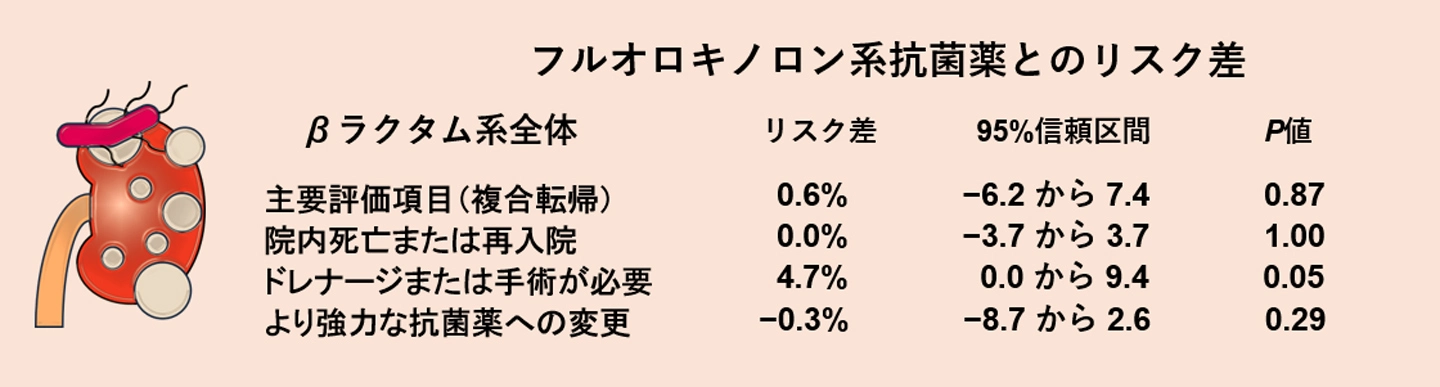
図1. フルオロキノロン系抗菌薬と比較したβラクタム系抗菌薬の治療成績
<関連情報>
- https://www.isct.ac.jp/ja/news/l04nsl6avodp
- https://www.kidneymedicinejournal.org/article/S2590-0595(26)00355-9/fulltext
腎嚢胞感染症疑いに対する経験的治療におけるβ-ラクタム系抗菌薬とフルオロキノロン系抗菌薬の比較:全国規模の観察研究 β-Lactams vs Fluoroquinolones for Empiric Treatment of Suspected Kidney Cyst Infection: A Nationwide Observational Study
Yuta Nakano, M.D. Ph.D. ∙ Rena Suzukawa ∙ Tamami Fujiki, M.D., Ph.D. ∙ … ∙ Kiyohide Fushimi, M.D., Ph.D. ∙ Shinichi Uchida, M.D., Ph.D. ∙ Shintaro Mandai, M.D., Ph.D
Kidney Medicine Published:October 22, 2026
DOI:https://doi.org/10.1016/j.xkme.2026.101592
Abstract
Rationale & Objective
Fluoroquinolones are commonly recommended for empiric treatment of suspected kidney cyst infections, largely on theoretical grounds, including lipid solubility and presumed cyst penetration. However, microbiological confirmation is not routinely obtained in clinical practice, and infection sites often cannot be localized on imaging, making empiric therapy unavoidable. Although β-lactams are used in clinical practice, their real-world effectiveness compared with fluoroquinolones remains unclear. This study compared clinical outcomes following initiation of β-lactam versus fluoroquinolone monotherapy.
Study Design
Observational study using a nationwide database.
Setting & Participants
We identified 868 adults hospitalized for a first episode of suspected kidney cyst infection who initiated antibiotic therapy between 2010 and 2022.
Exposures
Exposure was defined as receiving β-lactams (ampicillin/sulbactam, cefmetazole, and ceftriaxone) versus fluoroquinolones (levofloxacin and ciprofloxacin).
Outcomes
Clinical outcomes over 90 days included in-hospital death, readmission for cyst infection, need for drainage or nephrectomy, and antibiotic escalation. Medical costs and length of stay were also evaluated.
Analytical Approach
Inverse probability of treatment weighting was applied to balance baseline characteristics. Risk differences (RDs) with 95% confidence intervals (CIs) were estimated.
Results
Among 868 patients (51.2% women), 1.3% died during hospitalization, 5.0% were readmitted for cyst infection, 2.1% required nephrectomy, 12.6% underwent percutaneous drainage, and 16.9% required antibiotic escalation. β-lactams and fluoroquinolones showed similar risks across clinical outcomes (composite RD, 0.6%; 95% CI, −6.2 to 7.4). Among β-lactams, ceftriaxone showed a relatively smaller RD (composite RD, −2.7%; 95% CI, −9.9 to 4.6). Medical costs and length of stay were similar across antibiotics.
Limitations
Disease severity could not be fully assessed using the available data.
Conclusions
Empiric β-lactam therapy, particularly ceftriaxone, was associated with clinical outcomes similar to those of fluoroquinolones for suspected kidney cyst infections. These findings may help inform empiric antibiotic selection and support further investigation of ceftriaxone as a practical alternative.