2026-11-04 ロックフェラー大学
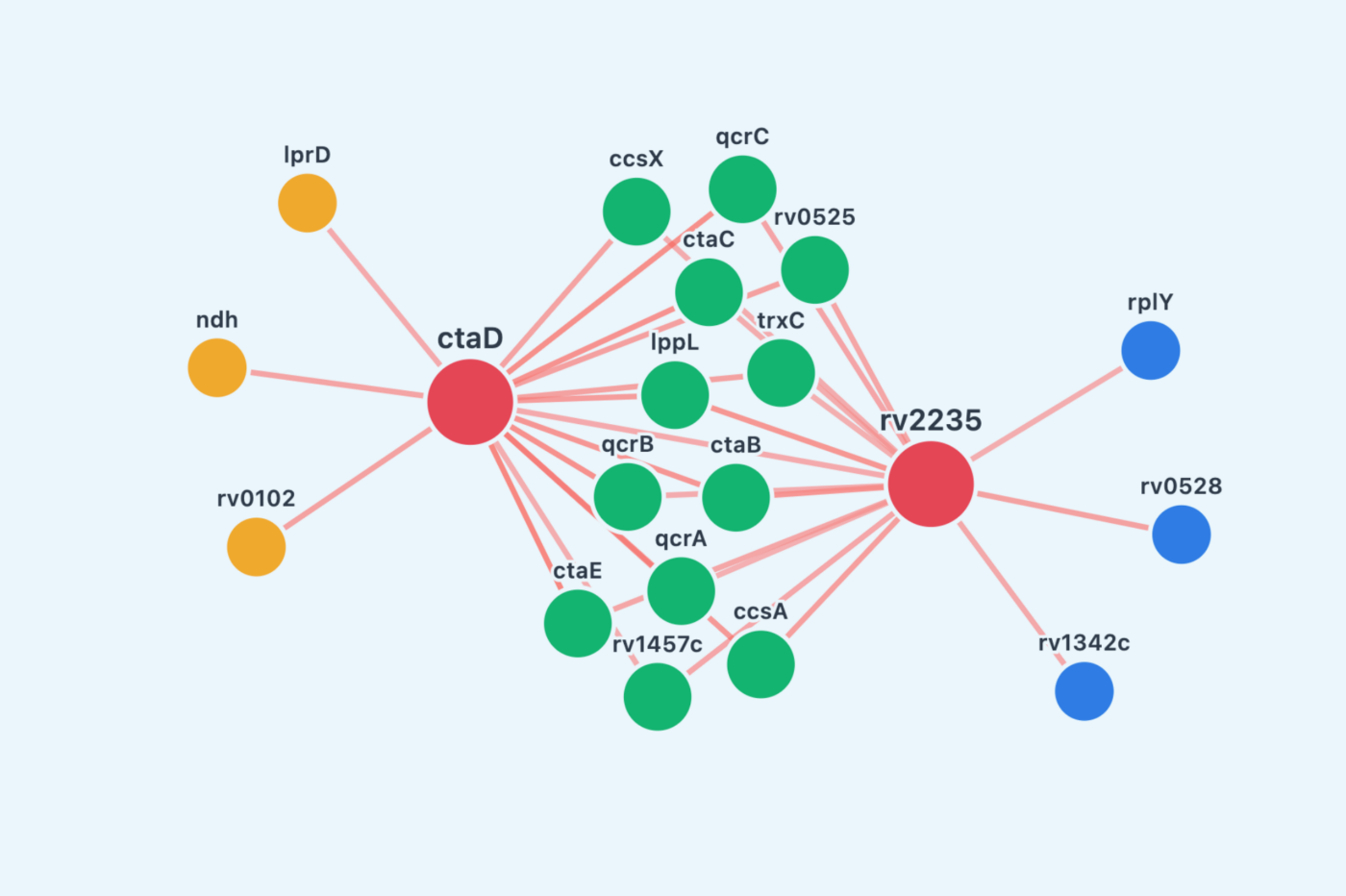
Genetic interaction networks, such as the one pictured here, allowed researchers to predict functions for previously uncharacterized genes. (Credit: Rock lab)
<関連情報>
- https://www.rockefeller.edu/news/40863-bacterial-genome-tb-drugs/
- https://www.nature.com/articles/s41586-026-11212-0
結核菌における必須遺伝子相互作用の包括的なマッピング Comprehensive mapping of essential-gene interactions in M. tuberculosis
Isaac J. Kresse, Natalie Y. Sayegh, Vanisha Munsamy-Govender, Allen Na, Samuel Nitz, Yaprak Ozakman, Barbara Bosch, Sebastian Gonzalez Behn-Eschenburg, Nicholas C. Poulton, Abhijna K. Reddy, Joshua Wallach, Rodrigo Aguilera Olvera, Anthony Castro, Heather Kim, Andrew I. Wong, S. Nicolai Tornow, Stephanie A. Bueler, Wayne W. H. Law, Michael S. Glickman, John L. Rubinstein, Dirk Schnappinger, Michael A. DeJesus & Jeremy M. Rock
Nature
DOI:
Abstract
Mycobacterium tuberculosis, the causative agent of tuberculosis, remains the world’s deadliest pathogen1. Despite intensive study, many of its genes remain uncharacterized, which limits the insight that can be gained into tuberculosis biology and constrains drug development. Genetic interaction (GI) mapping is a powerful strategy to define functional relationships between genes by quantifying how the phenotypic effects of combined perturbations deviate from expectations based on single-gene perturbations2,3. Here we develop a dual-sgRNA CRISPR-interference platform that enables high-throughput GI mapping in mycobacteria. We address key technical challenges in library construction and data interpretation by incorporating unique barcodes for each sgRNA pair and implementing a robust statistical pipeline for GI detection. Focusing on essential genes, we generate comprehensive GI maps in the model mycobacterium Mycobacterium smegmatis and the pathogen M. tuberculosis. These maps recapitulate known biology, uncover thousands of previously unrecognized interactions and identify functional connections between essential genes and drug targets. By generating AlphaFold3-based protein–protein interaction predictions4 for all gene pairs in our GI maps, we show that a subset of GIs is likely to reflect underlying physical associations. Validation of selected GIs confirms both novel biological relationships and opportunities for synergistic targeting. Overall, this work establishes a generalizable framework for dual-gene perturbation and defines the architecture of essential-gene networks in mycobacteria, advancing both our understanding of tuberculosis biology and the rational design of combination therapies.