2026-11-05 東北大学
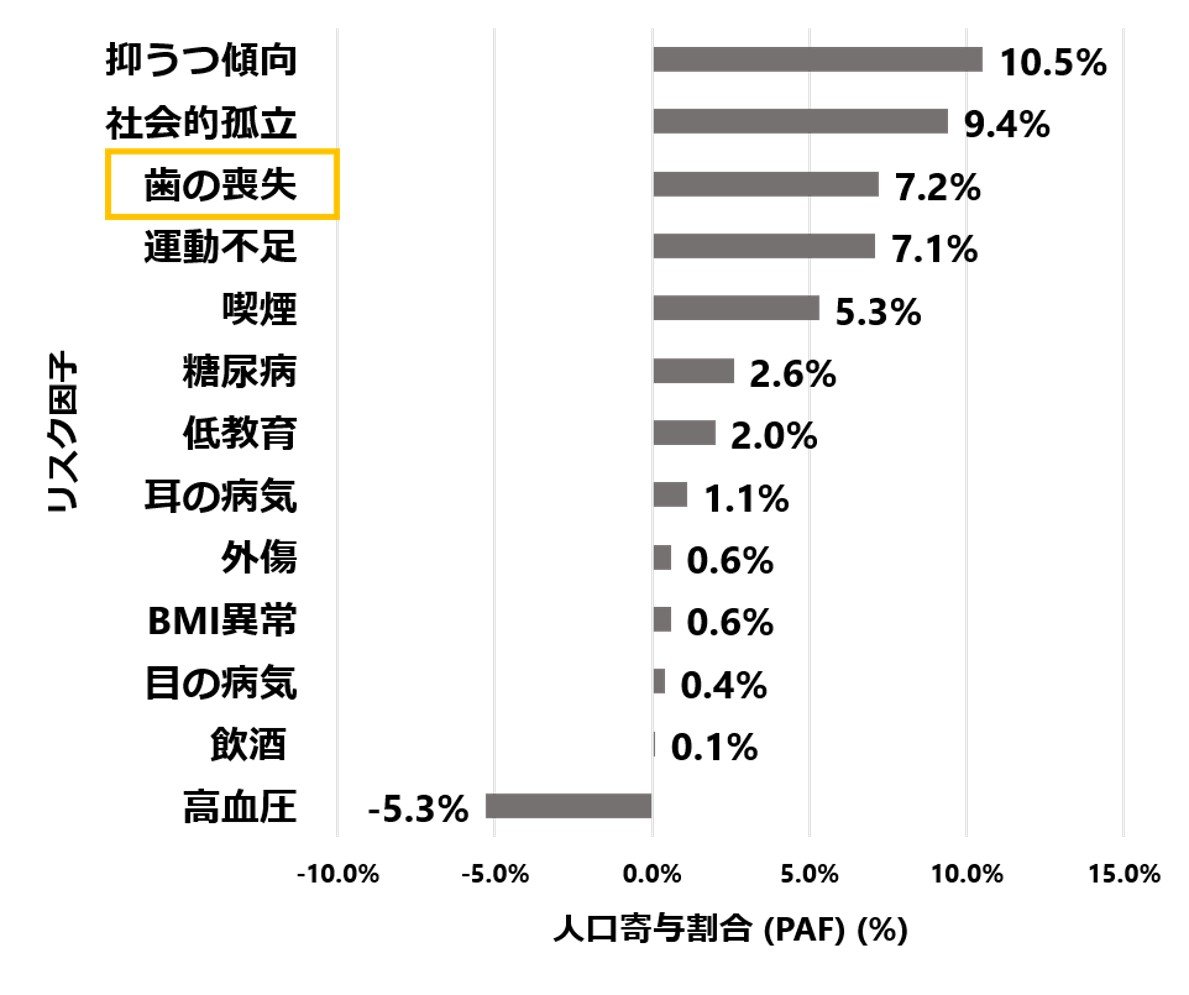
図1. 13のリスク因子の認知症発症の人口寄与割合(PAF)
<関連情報>
- https://www.tohoku.ac.jp/japanese/2026/11/press20261105-05-modifiable.html
- https://www.sciencedirect.com/science/article/pii/S1525861026004263
口腔衛生と認知症の既知の修正可能な危険因子が人口に及ぼす影響の比較:9年間の人口ベースのコホート研究 Comparative Population Impact of Oral Health and Established Modifiable Risk Factors for Dementia: A 9-Year Population-Based Cohort Study
Maho Iwata,Taro Kusama PhD,Jun Aida PhD,Tatsuo Yamamoto PhD,Kokoro Shirai PhD,Ken Osaka PhD,Kenji Takeuchi PhD
Journal of the American Medical Directors Association Available online: 2 November 2026
DOI:https://doi.org/10.1016/j.jamda.2026.106536
Abstract
Objectives
Poor oral health, particularly tooth loss, has been proposed as a risk factor for dementia; yet, its population-level contribution relative to established risk factors remains unclear. We aimed to compare the population attributable fractions (PAFs) of tooth loss with those of modifiable dementia risk factors identified by the 2024 Lancet Commission on Dementia Prevention, Intervention, and Care.
Design
A 9-year follow-up prospective cohort study from 2013 to 2022.
Setting and Participants
Functionally independent older adults aged ≥65 years living in 22 municipalities in Japan, who were free of dementia at baseline.
Methods
The outcome was dementia incidence, and the exposures included tooth loss and 12 modifiable risk factors identified by the Lancet Commission. Cox proportional hazards models adjusted for sex, age, and equivalent income were used to estimate hazard ratios (HRs) and 95% CIs. PAFs for each risk factor were calculated using the HRs.
Results
A total of 47,293 participants were included (46.7% male). The mean age was 73.5 years (SD, 6.1). During a median follow-up of 9.0 years, 17.4% developed dementia. Compared with ≥20 teeth, dementia risk increased with fewer teeth: HR, 1.14 (95% CI, 1.08-1.21) for 10 to 19 teeth, HR, 1.12 (95% CI, 1.05-1.19) for 1 to 9 teeth, and HR, 1.27 (95% CI, 1.18-1.36) for 0 teeth. The PAF for tooth loss was 7.2%, ranking third among the 13 risk factors examined, following depressive symptoms (10.5%) and social isolation (9.4%). In men, tooth loss ranked first (12.0%).
Conclusions and Implications
Tooth loss accounted for a substantial proportion of dementia cases, comparable to major risk factors. These findings suggest oral health as a key dementia risk factor and support its inclusion in dementia prevention strategies.