2026-11-05 中国科学院(CAS)
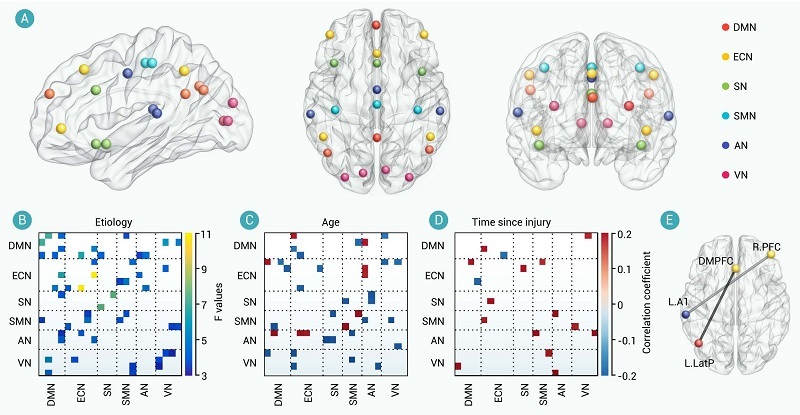
Relationship between brain network connectivity and clinical characteristics (Image by YANG Yan’s group)
<関連情報>
- https://english.cas.cn/newsroom/research-news/202611/t20261105_1213287.shtml
- https://www.the-innovation.org/article/doi/10.59717/j.xinn-life.2026.100266
意識障害における脳ネットワークの接続性には、患者固有の要因が関連している Patient-specific factors are associated with distinct brain network connectivity in disorders of consciousness
Huan Wang, Qianqian Ge, Shuai Han, Kaitian Chen, Aoxuan Liu, Qiuyou Xie, Peng Zhang, Sheng He, Jianghong He, Yan Yang
The Innovation Life Published:October 20, 2026
DOI:https://doi.org/10.59717/j.xinn-life.2026.100266
Public Summarry
- Clinical characteristics are associated with distinct large-scale brain network connectivity.
- Etiology related connectivity are closely linked to patients’ consciousness level and functional recovery.
- Internetwork connectivity accounted for greater functional recovery in traumatic brain injury patients.
Abstract
Disorders of consciousness (DoC) arise from diverse etiologies and exhibit substantial clinical heterogeneity, including variations in patient age and time since injury. However, how these clinical characteristics relate to large-scale brain network connectivity and are associated with consciousness levels and functional outcomes remains poorly understood. In this study, resting-state functional magnetic resonance imaging (rs-fMRI) data from 128 DoC patients were analyzed. Functional connectivity (FC) patterns linked to key clinical characteristics were identified using an explainable machine learning framework. Statistical path analysis was then employed to assess whether intra- and inter-network FC account for the statistical effects of clinical characteristics on consciousness level and functional recovery. Patients with traumatic brain injury (TBI) and younger age exhibited higher consciousness levels and greater recovery potential, whereas time since injury showed no such relationship. Each clinical characteristic corresponded to distinct, largely non-overlapping FC patterns distributed across different large-scale brain networks. Notably, etiology-related intra- and inter-network connectivity reliably indexed patients’ recovery outcomes. Statistical path analysis further demonstrated that inter-network FC could statistically account for the superior recovery observed in TBI compared to anoxic patients. Clinical characteristics are associated with large-scale brain network connectivity in DoC, and are linked to the potential of functional recovery through these connectivity patterns. These findings highlight the value of integrating clinical-contextualized connectivity biomarkers into individualized prognostic assessment and therapeutic strategies.