2026-11-06 東北大学
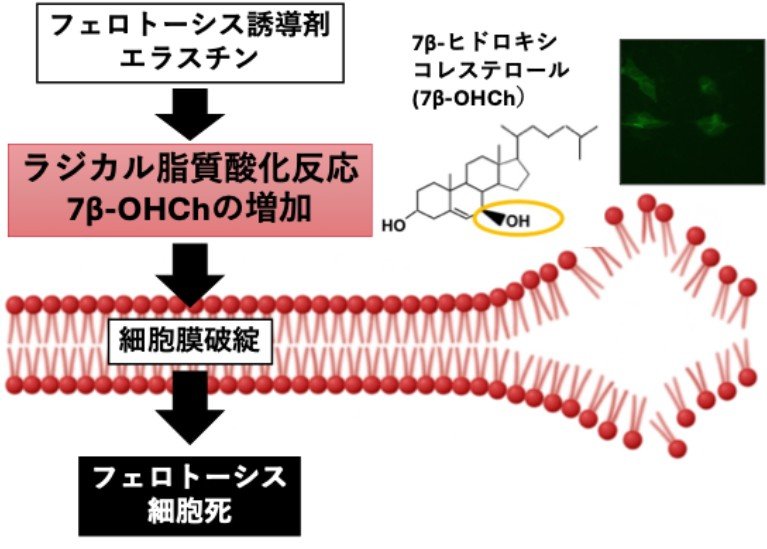
図1. 本研究の概要:フェロトーシス誘導におけるコレステロールの酸化
<関連情報>
- https://www.tohoku.ac.jp/japanese/2026/11/press20261106-02-ferroptosis.html
- https://www.sciexplor.com/exo/articles/EXO.2026.0022
エラスチン誘導性フェロトーシスにおけるラジカルを介したC7コレステロール酸化 Radical-mediated C7 cholesterol oxidation during erastin-induced ferroptosis
Yuta Akiba,Kotoko Arisawa,Takayuki Kaneko,Kei Ishida,Emiko Sato,Takashi Toyama,Yoshiro Saito
EXO – Beyond the Cell Published: October 28, 2026
DOI:https://doi.org/10.70401/EXO.2026.0022
Abstract
Aims: Ferroptosis is driven by iron-dependent lipid peroxidation, but whether cholesterol undergoes radical-mediated oxidation during this process remains incompletely understood. We examined the temporal relationship between lipid peroxidation, cell death, and C7 cholesterol oxidation during erastin-induced ferroptosis.
Methods: Human SH-SY5Y cells were treated with erastin. Cell viability, lipid hydroperoxides, and lipid radicals were assessed using Alamar Blue, Liperfluo, and LipiRADICAL, respectively. Total 7α-hydroxycholesterol (t7α-OHCh), total 7β-hydroxycholesterol (t7β-OHCh), and 7-ketocholesterol (7-ketoCh) were quantified by gas chromatography–mass spectrometry (GC–MS) after triphenylphosphine reduction and saponification.
Results: Erastin-induced cell death was suppressed by deferoxamine, ferrostatin-1, and α-tocopherol. Liperfluo fluorescence increased before detectable LipiRADICAL fluorescence and loss of cell viability. t7α-OHCh increased during the early phase, whereas t7β-OHCh increased later; no statistically significant change in 7-ketoCh was detected. Because t7α-OHCh and t7β-OHCh represent composite pools of pre-existing free and esterified hydroxycholesterols and hydroperoxide-derived products, the early t7α-OHCh signal cannot distinguish enzymatic hydroxylation from a 7α-hydroperoxycholesterol (7α-OOHCh)-derived product. The increase in t7β-OHCh together with the overall C7 stereochemical profile is consistent with radical-mediated C7 cholesterol oxidation.
Conclusion: These findings support radical-mediated C7 cholesterol oxidation as an early component of erastin-induced ferroptotic lipid damage. The biological activity and extracellular transfer of these products remain to be established.