2026-11-16 カリフォルニア大学サンタクルーズ校(UCSC)
<関連情報>
- https://news.ucsc.edu/2026/11/gaplinc-sepsis-control/
- https://www.pnas.org/doi/10.1073/pnas.2616060123
Gaplincはエンドトキシンショックにおいて骨髄系細胞の代謝経路をトランスに制御する
(Gaplinc regulates myeloid metabolic pathways in trans in endotoxic shock)
Valeriya Smaliy, Diana Escalona, Steven Liang, Lisa Sudek, Apple Cortez Vollmers, Sol Katzman, Stephanie Smith-Berdan, Eric Malekos, Juan Antonio Aguilar-Pimentel, Birgit Rathkolb, Helmut Fuchs, Valerie Gailus-Durner, Martin Hrabe de Angelis, Alexa Mozqueda, David F. Boyd, Judith Hellman, E. Camilla Forsberg, Susan Carpenter
Proceedings of the National Academy of Sciences of the United States of America (PNAS), Volume 123, Issue 47, Article e2616060123 (2026)2026-11-16
DOI:10.1073/pnas.2616060123

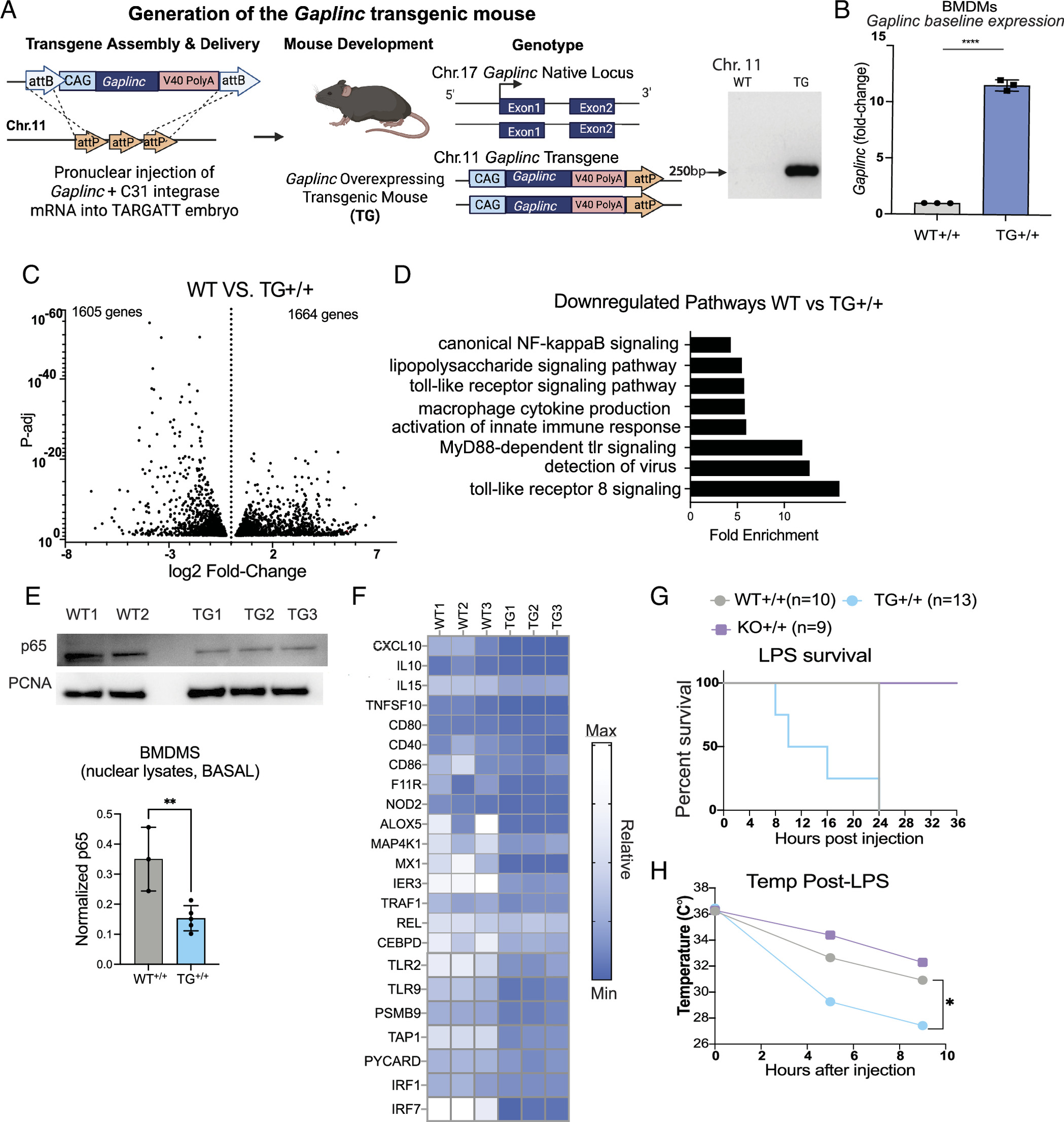
Gaplinc transgenic overexpressing mice are more sensitive to endotoxic shock and show altered expression of NF-κB regulated genes at baseline. (A) Schematic of Gaplinc transgenic mouse design utilizing TARGATT technology and PCR confirmation of genotype using transgenic specific primers. (B) RT- qPCR analysis of Gaplinc fold change expression in WT and Gaplinc TG BMDMs (n = 3). Error bars represent SD. ****P < 0.0001. (C) Volcano plot representing DESeq differential expression analysis of BMDMs comparing WT and Gaplinc-TG mice (n = 3) following RNA-seq. (D) GO-Term analysis on significantly down-regulated genes comparing WT and TG BMDMs (n = 3). Genes with adjusted P-value (Padj) < 0.1 were considered significant. (E) Heat map represents gene expression of p65 direct target genes down-regulated upon Gaplinc overexpression. (F) Western blot analysis measuring p65 in the nuclear fraction of WT and Gaplinc TG BMDMs (n = 3) at baseline. (G) Survival data of WT and Gaplinc-KO and GAPLINC-TG mice are shown in response to E. coli LPS challenge (5 mg/kg/mice) (n = 6-10). The statistical test of differences was calculated using the Log-rank (Mantel-Cox) test. ***P < 0.001. (H) Changes in body temperature of WT, Gaplinc-KO mice Gaplinc-TG were recorded at the indicated time points. **P < 0.01.
出典:Smaliy et al., “Gaplinc regulates myeloid metabolic pathways in trans in endotoxic shock,” Proceedings of the National Academy of Sciences, 2026. DOI: https://doi.org/10.1073/pnas.2616060123. Licensed under CC BY 4.0.
敗血症やエンドトキシンショックでは、免疫応答の過剰な活性化と代謝異常が重なり、治療が難しい全身性炎症を引き起こす。本研究は、自然免疫を制御する長鎖非コードRNA(lncRNA)であるGaplincが、免疫応答と全身代謝を結び付ける役割を解明した。マウスを用いた実験では、Gaplincを欠損させると、平常時の免疫応答関連遺伝子の発現が上昇し、リポ多糖(LPS)誘発性ショックへの抵抗性が高まった。一方、Gaplincを過剰発現させると免疫応答が抑制され、エンドトキシンに対する感受性と死亡率が増加した。また、Gaplincはミトコンドリア酵素MCCC1と結合し、ロイシン代謝に関係する経路を介して代謝状態に影響することが示された。Gaplinc欠損マウスではミトコンドリア由来活性酸素が減少し、リゾホスファチジルコリンの増加や遊離脂肪酸の減少を特徴とする脂質代謝変化が認められた。さらに、骨髄系細胞特異的な欠損でも部分的な保護効果が確認された。これらの結果は、Gaplincの発現量が免疫応答と代謝恒常性のバランスを左右し、重症炎症に対する生存を決定する重要な因子であることを示している。
Sepsis and endotoxic shock involve dysregulated immune responses and metabolic disturbances, making severe systemic inflammation difficult to treat. This study investigated how Gaplinc, a long noncoding RNA (lncRNA) involved in innate immune regulation, connects immune activity with systemic metabolism. In mouse models, Gaplinc deficiency increased the baseline expression of immune response genes and conferred resistance to lipopolysaccharide (LPS)-induced shock. In contrast, Gaplinc overexpression suppressed baseline immune responses and increased susceptibility to endotoxemia and mortality. Mechanistically, Gaplinc was found to interact with the mitochondrial enzyme MCCC1, linking its regulatory activity to metabolic pathways associated with leucine catabolism. Gaplinc-deficient mice exhibited reduced mitochondrial reactive oxygen species and systemic lipidomic changes characterized by increased lysophosphatidylcholines and decreased free fatty acids. Myeloid-specific Gaplinc deletion also provided partial protection against LPS-induced hypothermia. These findings establish Gaplinc transcript abundance as an important regulator of immune and metabolic homeostasis and suggest that lncRNA-mediated metabolic reprogramming may provide a conceptual basis for developing strategies against severe systemic inflammation.
原論文:PNAS掲載ページ