2026-11-19 理化学研究所,東北大学,科学技術振興機構
<関連情報>
- https://www.riken.jp/press/2026/20261119_1/index.html
- https://onlinelibrary.wiley.com/doi/10.1002/anie.8646657
スイッチ型有機光触媒を用いた段階的近接標識法(Stepwise Proximity Labeling with a Switchable Organophotocatalyst)
Takumi Kariya, Shinichi Sato, Keita Nakane, Syusuke Egoshi, Mikiko Sodeoka, Kosuke Dodo
Angewandte Chemie International Edition 2026-11-19 Early View
DOI:10.1002/anie.8646657

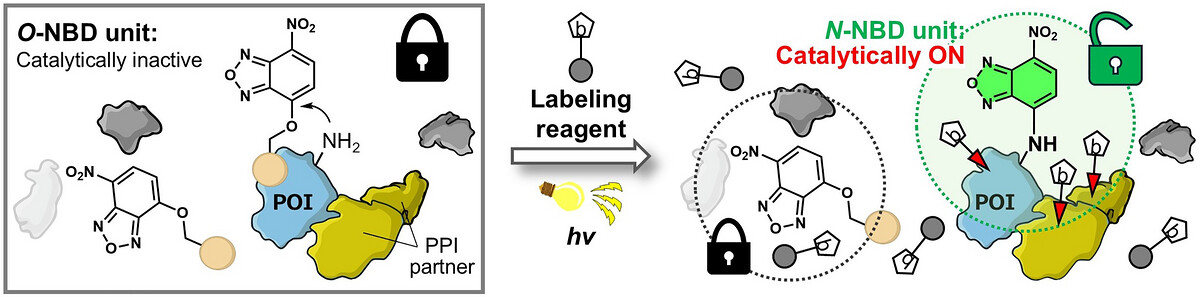
Graphical Abstract The O-nitrobenzoxadiazole (O-NBD) unit, originally developed for affinity labeling, is catalytically inactive. However, after reacting with a lysine residue of the protein of interest (POI), the resulting N-NBD catalyzes the labeling reaction. This switchable proximity labeling approach utilizing the NBD unit selectively labels an interacting partner of the POI and suppresses the nonspecific labeling caused by free catalysts. CC BY 4.0
細胞内のタンパク質は周囲の分子と相互作用しながら機能しており、特定のタンパク質の近傍に存在する分子を網羅的に調べることは、生命現象や医薬品の作用機序を理解するうえで重要である。光近接標識法は、標的タンパク質の近くに光触媒を配置し、光照射によって標識試薬を活性化して周辺タンパク質に目印を付ける技術だが、標的に結合しなかった遊離光触媒も反応を起こし、不要な標識が生じる問題があった。本研究では、蛍光色素として知られるニトロベンゾキサジアゾール(NBD)を利用し、標的タンパク質と反応したときに初めて光触媒活性を獲得するスイッチ型光触媒を開発した。リガンドに結合したO-NBDは、標的タンパク質のリシン残基などに存在するアミノ基と反応してN-NBDへ変換され、この段階で光触媒として機能する。一方、未反応のO-NBDは活性を示さないため、細胞内に残存しても不要な標識反応を起こしにくい。ヒト培養細胞HEK293Tを用い、ミトコンドリア外膜のTSPOを標的とするリガンドで検証したところ、スイッチ型光触媒で標識されたタンパク質の81.2%がVDAC1と同じ領域に分布し、従来型光触媒の55.7%を上回った。さらに質量分析では、スイッチ型で標識されたタンパク質のうちミトコンドリアに局在するものの割合が高く、標的周辺への選択性が確認された。本技術は遺伝子操作によるタグ導入を必要とせず、創薬標的周辺のタンパク質解析や薬剤の作用機序・副作用の解明に役立つことが期待される。
Protein–protein interactions are essential for cellular functions, and identifying proteins surrounding a specific target is important for understanding biological processes and drug mechanisms. Photoinducible proximity labeling uses a photocatalyst positioned near a protein of interest to activate labeling reagents upon light irradiation. However, conventional approaches can produce unwanted labeling because photocatalysts that remain unbound to the target may also activate reactions elsewhere in the cell. This study developed a switchable organophotocatalyst based on nitrobenzoxadiazole (NBD), a compound commonly used as a fluorescent dye. The O-NBD unit attached to a target-binding ligand reacts with an amino group on the target protein, generating an N-NBD unit that acquires photocatalytic activity. In contrast, unreacted O-NBD remains inactive, reducing unwanted labeling by free photocatalyst. The system was tested in living HEK293T cells using a ligand targeting TSPO, a mitochondrial outer-membrane protein associated with VDAC. In fluorescence imaging experiments, 81.2% of proteins labeled by the switchable photocatalyst colocalized with VDAC1, compared with 55.7% for the conventional photocatalyst. Mass spectrometry further indicated more selective labeling of mitochondrial proteins with the switchable system. Because the method does not require genetic tagging of the target protein, it may facilitate the analysis of protein environments in cells that are difficult to genetically manipulate. Potential applications include identifying proteins associated with drug targets and investigating mechanisms of drug action and adverse effects.
原著論文:Wiley Online Library