
たてがみの魅力: 長い頭皮の毛を制御する分子「スイッチ」の可能性(Mane attraction: Molecular ‘switch’ may control long scalp hair)

ad

2025-01-23 ペンシルベニア州立大学(PennState)

ペンシルバニア州立大学を中心とする研究チームは、頭髪の長さを調節する分子スイッチの存在を示唆する研究を発表しました。人間の頭髪の進化的起源を探る中で、長い髪を育てる能力は元来潜在的に存在し、二足歩行など特定の環境的・生物的条件下で活性化された可能性があると結論づけました。この分子メカニズムの理解は、将来的に脱毛症の新しい治療法につながる可能性があります。さらに、頭髪の進化は暑熱環境への適応や社会的シグナルとしての役割を果たしたとされています。

<関連情報>

ヒトの長い頭髪の進化 Evolution of long scalp hair in humans

Lo-Yu Chang, Maksim V Plikus, Nina G Jablonski, Sung-Jan Lin
British Journal of Dermatology  Published:22 January 2025
DOI:https://doi.org/10.1093/bjd/ljae456

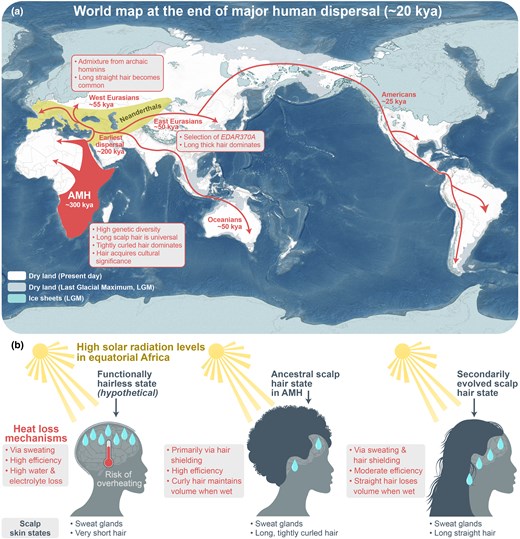
Evolution of scalp hair traits in anatomically modern humans (AMHs). (a) AMHs evolved in Africa approximately 300 thousand years ago (kya). African AMH populations were genetically diverse and broadly featured long, tightly curled scalp hair, which was styled for visual communication. Upon dispersal from Africa starting approximately 200 kya (red arrows), AMHs had contact with and experienced genetic admixture from archaic humans (the area showing the Neanderthals’ range is shaded in yellow). From Western Asia, humans dispersed into Europe, Oceania, Central and Eastern Asia, and then into North and South America (around 25 kya). Long scalp hair remained a universal anatomical feature in all non-African populations, while hair curliness and thickness further diversified. Dispersal history of AMHs is adopted from Nielsen et al.93 Further information on the timeline of hominin evolution is provided in Figure S1 (see Supporting Information).94–96 The background image represents an approximate world map during Last Glacial Maximum (LGM), approximately 20 kya. (b) The proposed primary role of long, tightly curled scalp hair in AMHs. The Equatorial Africa region represented the original ecological niche of AMHs and was characterized by high-intensity solar radiation. The human head was exposed to direct sunlight, posing a risk of overheating which could affect the brain. To counter overheating, increased sweat gland density enabled active heat loss via perspiration. However, perspiration results in significant loss of water and electrolytes (left). Evolution of long scalp hair enabled physical head shielding, reducing direct sunlight exposure of the skin and the required amount of perspiration (centre and right). However, long straight hair is prone to losing volume when wet, which decreases its head-shielding capacity (right), whereas long, tightly curled hair has better water resistance and maintains high volume, thus offering robust head-shielding efficacy (centre). Long, tightly curled hair evolved as the ancestral scalp hair state in AMHs.

Abstract

The ability to grow long scalp hair is a distinct human characteristic. It probably originally evolved to aid in cooling the sun-exposed head, although the genetic determinants of long hair are largely unknown. Despite ancestral variations in hair growth, long scalp hair is common to all extant human populations, which suggests its emergence before or concurrently with the emergence of anatomically modern humans (AMHs), approximately 300 000 years ago. Long scalp hair in AMHs was also a trait that was selected because it conveyed essential signals related to an individual’s age, sexual maturity, health and social status. Biologically, hair length is primarily determined by the amount of time that a hair follicle spends in the active growth phase (anagen). While anagen duration is typically tightly regulated in most mammals, the inherent ability of a hair follicle to continuously recruit new dividing progenitors to its base, where hair fibre is generated, theoretically removes limits on maximal anagen duration. We propose a model wherein hair cycle progression into and out of anagen is regulated by evolutionary malleable molecular checkpoints. Several animal species and domesticated animal breeds display long body hair, which suggests that extremely long scalp hair in humans emerged via attenuation of an existing out-of-anagen checkpoint mechanism rather than via a newly evolved molecular programme. Studying congenital and somatic mosaicism conditions featuring altered hair length could potentially unveil the currently unknown molecular basis underlying this human trait.

生物工学一般
ad
ad
Follow
ad
タイトルとURLをコピーしました