
2026-05-27 ミュンヘン大学(LMU)
<関連情報>
- https://www.lmu.de/en/newsroom/news-overview/news/signals-from-the-deep-brain-rhythms-distinguish-states-of-consciousness-2b5a9fb4.html
- https://www.nature.com/articles/s41562-026-02446-z
視床の振動は人間の自然な意識状態を区別する Thalamic oscillations distinguish natural states of consciousness in humans
Aditya Chowdhury,Xiongbo Wu,Tara Beilner,Thomas Schreiner,Thomas Koeglsperger,Jan-Hinnerk Mehrkens,Jan Remi,Christian Vollmar,Elisabeth Kaufmann & Tobias Staudigl
Nature Human Behaviour Published:27 May 2026
DOI:https://doi.org/10.1038/s41562-026-02446-z
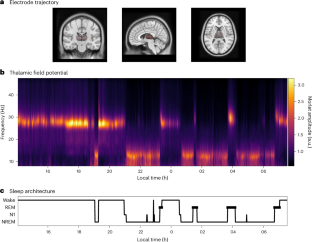
Abstract
Natural states of consciousness are thought to be regulated by deep brain structures such as the thalamus. However, very little is known about the underlying electrophysiology in humans. Here, using a rare opportunity to directly record from the human thalamus, we identify a hitherto-unreported brain-state-specific oscillation of approximately 19–45 Hz. This oscillation is present only during rapid eye movement (REM) sleep and wakefulness, while being absent during non-REM sleep. The 19–45 Hz oscillation further distinguishes REM sleep microstates, co-occurring with bursts of eye movements, and is specific to the central thalamus, a structure implicated in causing global brain state transitions. The discovery of a distinct oscillatory signature in the central thalamus that distinguishes conscious states opens up avenues to further investigate thalamic contributions to states of consciousness in humans and potentially to refine interventions to treat disorders of consciousness.

