2025-07-01 スイス連邦工科大学ローザンヌ校(EPFL)
<関連情報>
- https://actu.epfl.ch/news/a-recycling-mechanism-that-helps-cells-fight-aging/
- https://www.nature.com/articles/s41556-025-01693-y
ストレスに対するリソソーム監視応答が健康寿命を延ばす A lysosomal surveillance response to stress extends healthspan
Terytty Yang Li,Arwen W. Gao,Rendan Yang,Yu Sun,Yuxuan Lei,Xiaoxu Li,Lin Chen,Yasmine J. Liu,Rachel N. Arey,Kimberly Morales,Raya B. Liu,Wenzheng Wang,Ang Zhou,Tong-jin Zhao,Weisha Li,Amélia Lalou,Qi Wang,Tanes Lima,Riekelt H. Houtkooper & Johan Auwerx
Nature Cell Biology Published:26 June 2025
DOI:https://doi.org/10.1038/s41556-025-01693-y
Abstract
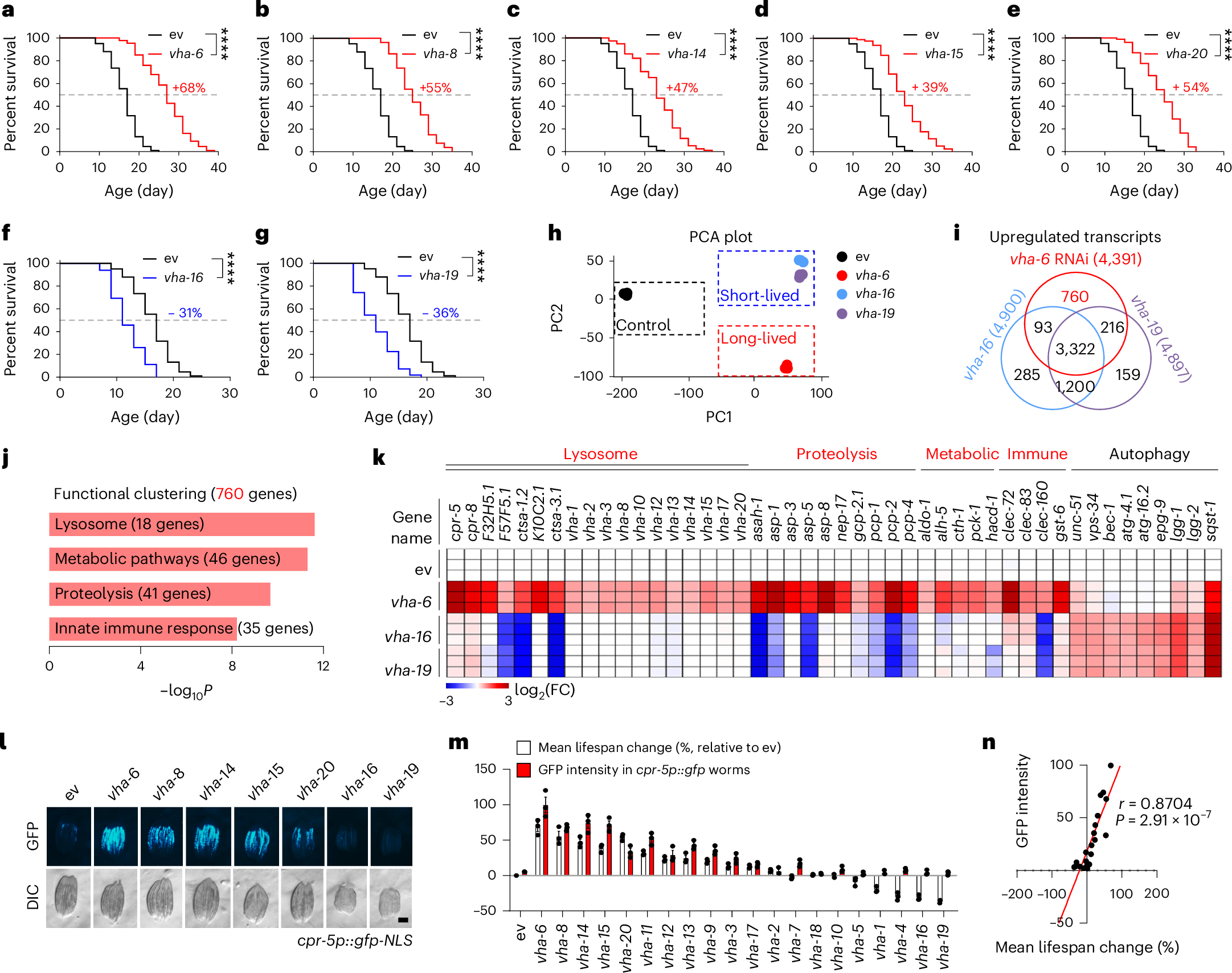
Lysosomes are cytoplasmic organelles central for the degradation of macromolecules to maintain cellular homoeostasis and health. However, how lysosomal activity can be boosted to counteract ageing and ageing-related diseases remains elusive. Here we reveal that silencing specific vacuolar H+-ATPase subunits (for example, vha-6), which are essential for intestinal lumen acidification in Caenorhabditis elegans, extends lifespan by ~60%. This longevity phenotype can be explained by an adaptive transcriptional response typified by induction of a set of transcripts involved in lysosomal function and proteolysis, which we termed the lysosomal surveillance response (LySR). LySR activation is characterized by boosted lysosomal activity and enhanced clearance of protein aggregates in worm models of Alzheimer’s disease, Huntington’s disease and amyotrophic lateral sclerosis, thereby improving fitness. The GATA transcription factor ELT-2 governs the LySR programme and its associated beneficial effects. Activating the LySR pathway may therefore represent an attractive mechanism to reduce proteotoxicity and, as such, potentially extend healthspan.