2025-09-05 京都大学
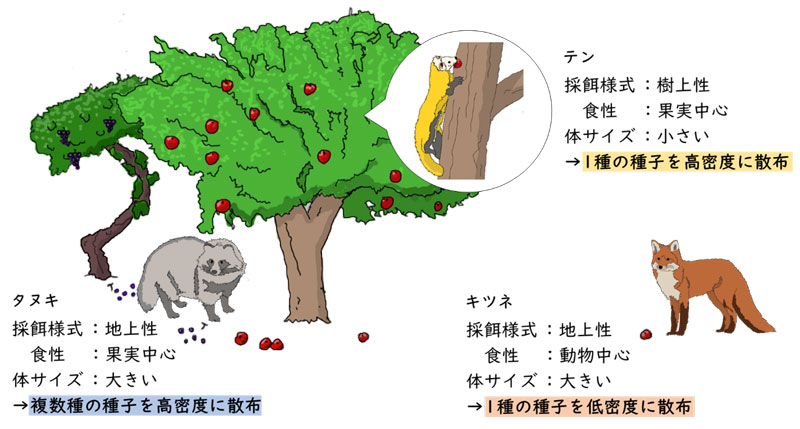
本研究の概要。生態的特徴の異なる3種の哺乳類間で糞内の種子組成と種子密度が異なる。
<関連情報>
- https://www.kyoto-u.ac.jp/ja/research-news/2025-09-05
- https://www.kyoto-u.ac.jp/sites/default/files/2025-09/web_2509_Yamawo-dd297778938767ae62836efb885b56f9.pdf
- https://www.sciencedirect.com/science/article/abs/pii/S1146609X25000554
種子堆積パターンは哺乳類種子散布者の採食行動と食性を反映する Seed deposition patterns reflect the foraging behavior and food habits of mammalian seed dispersers
Teruki Inoue, Kei Okuda, Yoshino Sakamoto, Rui Miyamoto, Haruka Kobayashi, Misaki Yokoyama, Akira Yamawo
Acta Oecologica Available online: 5 September 2025
DOI:https://doi.org/10.1016/j.actao.2025.104111
Abstract
In endozoochorous seed dispersal via animal gut passage, seeds are often deposited together with multiple conspecific and/or heterospecific seeds, potentially increasing the intensity of seedling competition. Ecological characteristics of the seed disperser species, such as the foraging behavior, food habits, and body size may influence seed composition and seed density in feces. To evaluate how the ecological characteristics of seed dispersers influence the competitive environment for seedlings, we compared the seed composition and density in the feces of three mammalian seed disperser species, martens, raccoon dogs, and foxes, that differ in foraging behavior, food habits, and body size. We collected 105 fecal samples, recorded 9385 seeds, and identified eight plant species. Seed composition in feces differed significantly among the three disperser species. Marten feces were primarily composed of Malus toringo (Siebold). In contrast, those of raccoon dogs and foxes were composed of a more diverse array of plant species. The density of seeds in feces tended to be higher in martens and raccoon dogs than in foxes. These results suggest that the competitive environments of seedlings differ depending on the ecological characteristics of disperser species and may have differential effects on seedling establishment.